03 March 2016 | Verder UK Ltd
Peristaltic pumps in biogas systems
Innovative biogas production with peristaltic pumps
This article was produced in conjunction with Lindhurst Engineering, providers of bespoke and modular engineering solutions to the energy, utilities, construction, food and drink and transport sectors.Within the agricultural economy, turning animal manure into a usable fuel has considerable economic and environmental attractions. Firstly, the application of anaerobic digestion (AD) produces highly quality methane gas which can be used for power generation. Secondly, the treatment process can reduce substantially the Chemical Oxygen Demand (COD) content.
Whilst there are many thousands of AD sites across Europe, it is still an industry in its infancy and considerable research is being undertaken to make it more commercially viable as a renewable power source.
The University of Nottingham Department of Chemical and Environmental Engineering working with Lindhurst Engineering has developed Microbial Fuel Cells systems that are pioneering a new approach to AD, converting cow slurry into commercial volumes of methane gas. The process also provides cleaner wastewater and reduces odour emissions.
For Lindhurst Engineering, of Sutton in-Ashfield, specialists in innovative mechanical and electrical engineering services, the move into AD has evolved from its expertise in water and environmental engineering. As a result of its collaboration with the University of Nottingham, Lindhurst scaled up and built a prototype digester, the H²AD, which has been operating at the University’s Sutton Bonington Campus for almost two years. Using MFC technology, it is capable of reducing treatment time to just three days, and also reducing processing costs substantially.
Dr. Laura Porcu, Head of Research & Development at Lindhurst Engineering, was originally involved in the research project at the University of Nottingham Department of Chemical and Environmental Engineering, working on treating different types of wastewater and at the same time looking to produce renewal energy utilising the bacteria.“ The first prototype scaled up the laboratory research model from 25lt to 1m³ of treated wastewater,” explains Dr. Porcu. “Since then two larger pilot plants using slurry manure have been built.”
At the Sutton Bonington Campus the cow slurry manure is treated with the H²AD system and the Chemical Oxygen Demand (COD) level is reduced by at least 50%. It is then pumped back to the main slurry manure, this is because we are still developing and researching about a low cost back-end treatment to further polish the effluent. The eventual aim is to reach a level of grey water that can be reused onsite. Dr. Porcu continues: “At the moment we are producing around 10,000 litres of biogas per day with very high methane content (72%). We have also commissioned a small CHP unit on the site to generate heat and power for the farm. We are also producing dry bio fertilizer rich in Nitrogen that the farm can use without the limitations of Nitrogen Vulnerable Zones, or sell it for half the price of a conventional fertilizer, which is approximately £370.00 per ton.”
How it works
The H²AD is a containerised, modular system that uses a semi-continuous flow process with liquid manure pumped into the process tank where it remains for no more than 48 hours before being pumped out for disposal. The system is coupled either with a microbial fuel cell or a microbial electrolysis cell, depending on the operating conditions, and made from an array of anodes and cathodes connected to an electrical circuit. The bacteria naturally present in the slurry tend to grow all around the anode, forming a thick biofilm. The organic substrate is converted into methane, protons and electrons. The electrons flow from the anode via an electrical circuit. The protons migrate from the anode chamber to the cathode chamber, where they recombine with the electrons to form grey water. In addition, sustainable bio-hydrogen can be produced with the right conditions (pH, hydrogen partial pressure, flow).
Whereas in large AD systems the required temperature to stimulate the growth of bacteria is typically 37-40°C, for this process the temperature needed for converting organic compounds into hydrogen and/or methane is much lower, varying between 25°C and 30°C. The additional benefits are in reducing the chemical content used in the treatment process by 50% in only two days and producing biogas with shorter retention times than conventional AD, instead of the typical 20 or 30 days. Being a semi-continuous flow system, it is reliant on a steady flow of feedstock and this aspect of the process requires a reliable and effective pumping infrastructure.
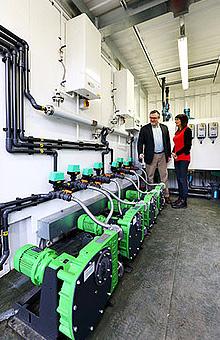
Following a review of the performance of the original pumps used in the first prototype, two Verderflex hose pumps were introduced. Such was their success that when it came to further scaling up and building two new units, Lindhurst Engineering turned once again to Verder for its pump requirements. The Verder VF25 peristaltic pumps that have been supplied more recently pump the wet slurry into the digester and then pull it out once it has gone through treatment. The pumps can be reversed to clear the suction lines and run dry without any problems. For this application, the pumps were specified to operate at speeds of 12-47rpm, a flow rate of up to 0.8m³/hr and deliver an operating pressure of 4 bar.
The Verder VF25 has a proven track record in the biogas processing industry, handling slurries containing mixed solids as well as those with a low viscosity level. Further factors that will be attractive to operators of the H²DA include the pump’s ease of use, low level of maintenance,economic running costs and international availability. (See our food waste focus here)
Agricultural potential
According to Lindhurst Engineering, the design goal of the H²AD is to treat slurry waste on a small scale at source much faster than the norm of 20 days. This opens up the technology to smaller farm units because there are no space-consuming large storage tanks, which makes the CAPEX costs a fraction of those for traditional anaerobic digestion plants. It means that they can make use of their own slurry, rather than tankering it off-site for processing, and generate power for the farm itself. “The clear potential for this innovative technology is in agriculture where 90% of all organic waste matter in the UK comes from and this is a massive untapped reserve,” continues Porcu. “Farmers that have invested in AD technology have typically had to spend in the region of £1 million, but to get the numbers to stack up they don’t always produce enough slurry and have to add to this maize. This presents an ethical dilemma of trading food crops for energy.
The H²AD is a hybrid technology between AD and microbial electrolysis cells where biogas is produced in the background at higher efficiency and it does not need to have the slurry enriched in order to produce an energy-rich gas. Currently, or focus is on producing methane since the quality of the slurry manure that is being treated is more suitable for methane production. However, the technology offers great potential for the pig and poultry sectors. ”The advantage of the H²AD system at the farm, other than reducing COD and producing heat and power, is that it can produce grey water that can be used on the farm. It can also produce dry fertilizer that is more advantageous to store and can be spread all year round without limitations.
Slurry can only be spread during a period of six weeks per year, depending on the location due to Nitrogen Vulnerable Zone regulations, which are becoming ever more stringent. Lindhurst Engineering is currently examining the liquid and semi-liquid food and drink waste sectors, where by reducing COD on site can bring down the high charges that result from the impact of the Mogden Formula operated by water treatment companies.
In this case the business can be even more attractive, comments Dr. Porcu. Having proved the effectiveness of the system at Sutton Bonington, Lindhurst engineering has now received further funding to build five more demonstration plants, of which two will be in the UK and the others in Spain, Denmark and Ireland. These will be fully functioning units that can produce gas in commercially viable quantities.