14 February 2024 | FLUX Pumps International UK
When and where should ATEX products be used?
ATEX products are crucial in environments at risk of explosive atmospheres, prevalent in industries like oil and gas, petrochemicals, and pharmaceuticals.
The necessity for ATEX-certified items stems from safety concerns, as explosive atmospheres occur when flammable substances mix with air and encounter an ignition source.ATEX directives, governing safety requirements for equipment in explosive atmospheres, are globally adopted standards, though specific regions like the United States have distinct regulations. Due to the complexity of ATEX directives, seek expert advice when dealing with flammable liquids, especially those with low conductivity or low flash points.
What is the ATEX Directive 2014/34/EU?
ATEX Directive 2014/34/EU guides equipment design to minimise explosion risk and contain failures. Compliance earns a CE mark and red Ex marking, with additional codes indicating suitability for various environments. The directive aims to prevent the spread of fire or explosion, employing "zone separation" methodology.
Moving parts like pumps and motors must adhere to the directive. On the other hand, non-moving parts may be deemed "intrinsically safe" or certified for electrical conductivity to avoid electrostatic charge risks.
What are typical ATEX products?
ATEX products form a diverse array of equipment, spanning:
1. Electrical gear: Such as switches, sensors, lighting fixtures, motors, control panels, and various electronic devices.
2. Mechanical machinery: Including pumps, compressors, fans, mixers, and other rotating equipment.
3. Protective systems: Ranging from explosion-proof enclosures to flame arresters, explosion venting panels, and suppression systems.
When are ATEX products essential?
ATEX products become essential once Zoned Area Classification, determined through assessments like DSEAR in the UK, outlines potential explosive zones. In industries such as petrochemical, chemical, mining, pharmaceutical processes, food production, and waste treatment, ATEX approval is crucial, due to the presence of flammable substances or explosive atmospheres.
What is DSEAR?
DSEAR, or The Dangerous Substances and Explosive Atmospheres Regulations 2002, mandates UK employers to manage safety risks related to fire, explosion, and substances corrosive to metals. DSEAR risk assessments align with Zoned Area Classification and considerations for ATEX equipment.
Zoned Area Classification, defining specific requirements for ATEX products, categorises areas based on the likelihood and duration of explosive atmospheres. Gas and vapor zones range from Zone 0 to Zone 2, while dust zones span Zone 20 to Zone 22, with lower zone classifications indicating a higher likelihood of explosive atmospheres.
What are ATEX certified pumps?
ATEX certified pumps are designed for operation in potentially explosive atmospheres, ensuring they avoid igniting flammable gas, vapours, or dust/air mixtures in hazardous environments. Industries like petrochemicals, pharmaceuticals, chemicals, and mining commonly employ ATEX pumps during activities involving dispensing, mixing, and transferring flammable fuels or solvents.
To adhere to ATEX standards, these pumps undergo rigorous testing, featuring construction from electrically conductive materials to minimise electrostatic charge risk. Components such as motors and switches use flame-proof enclosures to contain flash fires, with intrinsically safe elements incorporated. Safety features include earth connection points, explosion-proof enclosures, thermal overload protection and sealed cable glands.
Notably, ATEX approved pumps may be necessary even when handling non-flammable liquids if situated in a Zoned area.
When should you use ATEX pumps?
Employ ATEX pumps by adhering to straightforward criteria:
1. Use in a designated Zoned area, determined through Zoned Area Classification or DSEAR risk assessment.
2. When pumping flammable liquids with a flash point below 50°C.
3. When transferring low-conductivity flammable liquids, where electrostatic charge dissipation is slow, particularly those with a low flash point.
Considerations when handling flammable liquids:
- High flow rates, filtration, separation, and mixing can increase electrostatic charge, raising the risk of sparks.
- Avoid splash-filling vessels to minimize excess vapor production.
- Small bore pipes, bends, and valves can elevate electrostatic charge.
- Adhere to earth bonding requirements.
- Ensure hoses and fittings are conductive and certified to dissipate electrostatic charge effectively and eliminate potential electrical differences in the pumping system.
Options for ATEX explosion-proof pumps at Flux Pumps:
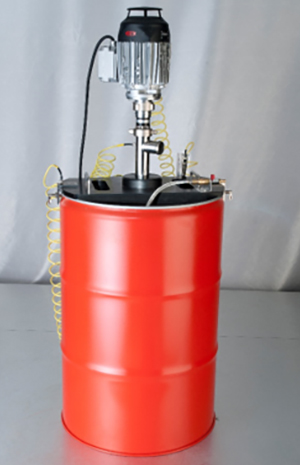
- A range of Ex drum and barrel pumps and air-operated double diaphragm pumps suitable for Zoned areas, identified by the red Ex symbol.
- Flux ATEX drum pumps primarily constructed from 316 stainless steel, featuring conductive PTFE bearings and impellers.
- ATEX centrifugal pumps, including FP424, F430, and F425 series models designed for low viscosity fluids, with the F430S FOOD approved for food and beverage applications.
- VISCOPOWER Ex-approved progressive cavity drum pumps available for high viscosity applications.
- Electric motors (F460 and FBM4000) and compressed air-powered motors (F416) with Ex certification, dispelling the misconception of compressed air motors being safer in Zoned areas.
- Flux ATEX impeller pumps with varying costs depending on factors such as size, type, motor power, and construction materials, ranging from £1,500 to over £4,000 for progressive cavity pumps.
- RFM series air-operated ATEX diaphragm pumps constructed from conductive PTFE and polypropylene materials, offering options for handling specific fluids.