02 September 2025 | Monowa Operable Wall Systems Ltd
Everything you wanted to know about Movable Walls but Were Afraid to Ask…
Over the years we have been doing this, the understanding or rather, the ‘misunderstanding’ of clients regarding moving walls and technicalities within the Movable Wall and Sliding Folding Partition world hasn’t really gotten any better.
We do understand that ours is a niche element to any construction or refurbishment project which may well be the answer, however a better understanding of what is available and how to enquire will result in a better experience for anyone planning a scheme.
The following should assist you with a better idea of what these Movable Wall and Sliding Folding Partitions are about, how they work, how to add them to a scheme and generally get you more in the know…
What’s in a Name?
Well, quite a bit really, clients use all sorts of names for our products so here is what to call them, why and how this can affect you enquiry…
Movable Walls
Now whilst this is a good generally term for any temporary acoustic division in a space, strictly speaking ‘Movable Walls’ consist of the following
Single Panels NOT joined together
Panels are individually operated with a crank handle
Held at the top on a carriage and moves along a head track
The carriage assemblies can either be single point or twin point
Each panel have a top and bottom acoustic seal which retracts into the panel to move them to the stacking area and extends (pushing towards the track and floor) when you put them out into position
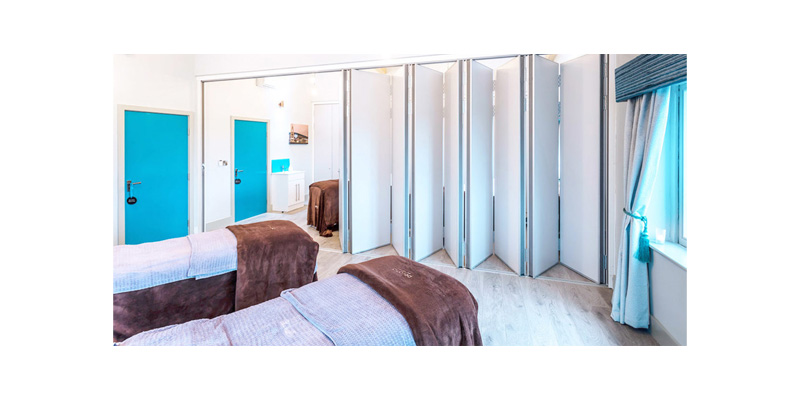
Sliding Folding Partitions
Similar to Movable Walls but are generally floor mounted, smaller and of a lower acoustic rating. Sliding Folding Partitions have the following characteristics:
Panels are joined together via hinges
Panels move out in a concertina fashion until the wall is set flat
General bottom rolling along a floor track (but can be top hung)
An operating key operates espagnolette bolts in every other panel and just locks into the track
Both the systems above are available in solid laminate finishes and fully glazed or semi glazed options depending on your requirements.
What system do you need?
As you can imagine there are a fair few factors involved in choosing which Movable Wall or Sliding Folding Partition best suits your, or your client’s needs.
Don’t worry you don’t need to know each and every intricacy of the systems. They main aspects can be covered in the points below to give you the best direction to go in and then we can take this further for you.
So, lets start…
Budget
Seems obvious but after all this is one of the main considerations. Generally speaking, Movable Wall Systems are more expensive that their Sliding Folding Partition counterpart.
What will the Partition be dividing
This piece of information can really help us in creating the perfect solution for you in terms of sound attenuation, layout and other considerations such as the need for pass doors for example.
Sound Attenuation
This is one of the most important elements to choose, however if you are not sure it’s not the end of the world. We just need to know the point above to get a feel for what you will need.
Essentially sound attenuation specification is about limiting sound flanking from space to space divided. This is rated in decibels and generally speaking Movable Wall Systems can achieve higher sound attenuation levels over Sliding Folding Partitions. To give you a better idea see the examples below:
A space divided where noise transfer is not the biggest factor you could choose Rw45dB specification system
A office meeting room may require an Rw50dB to Rw55dB specification
A more confidential meeting room would probably require the higher Rw55dB + especially if there are conference calls going on where the speakers will naturally create higher sounds
The orthogonal build up around our system must be to an adequate specification. Most remediation works following installation relating to sound transfer are not actually to do with our system but with issues with the construction around it.
Structural Soffit
All Movable Wall Systems (or top hung Sliding Folding systems) require a structural soffit to take the head supports and more importantly the weight. Structural soffits can be a solid concrete raft, a steel beam or a solid large timber. If these are not available you will need to either consider a secondary steel or moving to a Sliding Folding Partition (bottom rolling system), as the weight of these systems is taken at the base.
Fire Ratings
Whilst we can offer 30 minute or 60 minute fire rating you must bear in mind the system could be in the stacked position in the event of a fire breaking out.
An alternative is our systems with a special coating on the facia boards to give surface spread of flame and minute ratings, depending on needs
You can also use our enquiry form on the website to get things going and we can contact you and talk you thought the options available.
What needs to be done on site?
Preparing Openings
In the respect of Movable Walls as already stated we require and structural soffit.
For Sliding Folding Partitions, we require suitable fixing points for the Head Guide Track, whilst this bears no weight it does stop any lateral movement at the head. This can be done by a 100 x 50 timber or ply directly above the inside of the plasterboard and securely fixed the full opening width. If however, you have a drop in ceiling grid and it would be difficult to provide 100 x 50 timber you can prepare ply liners which you drop into each tile along the centre line of the system. We require there to be no gap between the ceiling tile and the timber.
For both systems we require suitable fixing points at the vertical sides of the opening to screw fix the wall jambs to.
If the wall jambs are to be mounted to studwork with a plasterboard finish, such as a flat wall or, a nib we require a 100 x 50 timber or ply linings directly behind the inside of the plasterboard and securely fixed floor to head.
However, if there is block/brick work or solid concrete at each end we can use the appropriate fixings for this. It should be noted, if there is a plaster board that is to be fixed by ‘dot & dab’ there can be no voids between the plaster board and the solid wall, fixing the wall jamb will crush the plaster board and the sound attenuation will be compromised.
The floor must be in level by 2mm +/- if this is not the case you will need to level this, otherwise the system may not operate as well as it should. In exisiting and old buildings where floors are typically uneven, please contact us and we will confirm what we can do for you.
If there is underfloor heating going in this is another MAJOR consideration, especially if pass doors or junctions are required as part of the scheme and especially if the system is a bottom rolling Sliding Folding Partition. This is because there will need to be floor drilling involved. So, it is vital that we know about underfloor heating and the depth it is situated at from finished floor level.