22 September 2025 | Ether Solutions Ltd
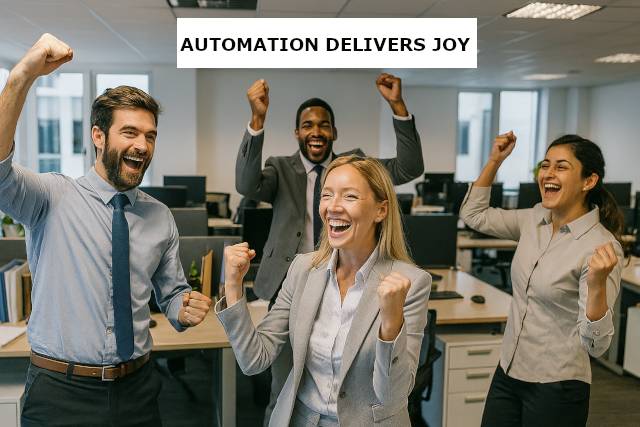
Automation Delivers Joy!
The famous quote from Mark Twain "Find a job you enjoy doing, and you will never have to work a day in your life"
It is ideal situation but for most businesses there is work to be done and people undertake the tasks as part of their job.
Automation can change the tasks that need to be performed. The result can be more Joy for the individuals impacted by the change.
Automation can be more than a great business case with an attractive ROI, it can transform the approach to work, and the activities people are required to undertake.
The L'Oréal tagline
"Because you are worth it"
applies to staff who could benefit from Automation of the repetitive tasks they perform. A good ROI is available as well.
1. Business Processes are fundamental for Automation!
A business process is the way something gets done.
Every business needs to have processes to deliver consistent outcomes for its customers.
Using a standard, predictable business process enables the activity to be undertaken by more than one person. It is the way a business scale with teams of people working effectively together.
It is the consistency and repetition that provides the potential for automation.
Any process can encounter errors and that is where knowledgeable people are often the best way to handle the situation.
2. Does anybody enjoy Repetition?
Yes, many people enjoy repetition because it provides a sense of stability, security, and comfort.
Repetitive tasks and experiences, such as listening to the same music or reading the same story, can also stimulate dopamine release in the brain, improving mood, and can be particularly helpful in developing skills.
Many Professions and Trades have used “Apprentices” to perform “Grunt” work consisting of repetitive low value tasks. It has been on the basis that doing lots of the same tasks built a skill that was necessary to enable higher value tasks to be completed.
If automation can remove the need for people to perform such low value tasks, how are they going to learn the skills?
Do people really need to perform low value tasks hundreds of times during several years of an apprenticeship, or can they learn the skill with just 10 iterations?
3. Does office work require Artisan Craft skills?
Manufacturing is based to producing the same outcome consistently and at scale.
Many activities in office work have similar requirements of consistent outcome.
Of course, people need to be treated as individuals. Some customer interactions with office staff benefit greatly from personal skills and these require time. These personal interactions are better when workers are not distracted by simultaneously working with complex IT systems. When automation reduces the effort from an office worker, more time is freed up for those personal interactions.
Although knowledge and skill are used to perform office work, the outcome does not usually show any artisan craft. There is no wood, pottery, metal or cake as the outcome, it is usually a digital result which then drives operational processes.
4. How much Joy is delivered by Automation?
As the implementation of automation provides joy to the staff released from the performance of manual activity, how does the amount of joy vary?
The biggest factor determining the amount of joy is the number of times a task had to be performed each day. The joy is probably greater if a task performed 50 times a day is automated rather a task which is repeated 10 times. More repetition, more Joy.
Relief is defined as temporary; it arises from the avoidance of an unpleasant or stressful activity. This can occur when automation is first deployed.
Automating a complex task may generate more relief than joy, if the complexity of the task required a lot of concentration to avoid errors.
Whereas Joy is associated with a deeper state of well-being. Staff knowing that they do not have repetitive boring tasks to perform can deliver joy for many weeks.
Memories of the tedious work will fade over time, and the Joy will reduce as it becomes an "Expected" way of working.