08 December 2025 | Long Range Systems UK Ltd
How to Choose The Best Two Way Radio Systems for Your Exact Needs
How to Choose The Best Two Way Radio Systems for Your Exact Needs Whether you want to keep in touch while on vacation or leisure activities like keeping tabs on hikers who are walking at different speeds, and of course for example in a business ensuring safety of staff through lone worker two-way radios; two-way radios are light and robust and so ideal for most communication tasks and for business are often essential for so many tasks like security, safety and many more tasks.
Choosing the Right Equipment is Critical!
Essentially, there are a few basic configurations that are critical that can greatly affect the outcome and usefulness of the device so its important to make your selection about transmission types; walkie talkies are widely used in a number of different settings, and need consideration about the mode of transmission etc. when thinking how to choose what's best for the application, for example:
* UHF (Ultra High Frequency). This UHF frequency has a shorter wavelength so the signal can more easily find its way across rough terrain or inside a building for example. UHF is good for using inside buildings and more channels are available. In more densely populated areas, there may be less likelihood of interference from other systems. UHF wireless radios are sold in volume at LRS UK and they have supplied recently an order (from one customer) 4090 handsets at great pricing and with excellent support.
* VHF (Very High Frequency). The VHF frequency has a longer wavelength meaning it can transmit across greater distances when conditions are good. Unless the area is especially rugged or wooded, VHF is great for use outdoors. From LRS experience they don't supply as many VHF handsets.
In 2026 there is much more to consider that will affect the choice of wireless radio rather than 'just' the frequency of the device. Recent enhancements of technology have created a whole new technology based on digital signals. The main advantages of these newer type of devices is that the communication audio firstly is crystal clear. But sadly, compared to the old 'analogue' systems the digital solutions are incompatible unless you opt for a 'hybrid' radio that can communicate to either type of product. Today, hybrid handsets are very common because business needs a way to 'migrate' from analogue to digital platforms.
One of the newest technology examples in two-way radio is called a Push-to-Talk over Cellular, also known as PoC LTE technology that has also stepped in and is getting more common. With the arrival of PoC handsets the main advantage of this technology is range and clarity.
Coverage and Range with Modern Handsets
You will often see claims of various handset ranges from many dealers and 'experts', generally expressed in miles or Kilometers, and displayed on packaging and clearly advertised by manufacturers. These specified distances or ranges tend to be based on transmissions in the best possible conditions for the transmission, with an uninterrupted sight line between you and the other radio you are communicating with, and at a very good height in good or perfect weather. The reality could be and nearly always is very different, so expect less, sometimes far less, than what those optimal conditions could produce, and for the overall range to given frequently it will be less than the maximum claimed.
While many makers will claim up to 8Km range, in the great majority of situations, you can realistically expect a range of a good couple of 2 to 3 Kilometers, less if you are inside a vehicle. Performance can be affected greatly by:
* Poor weather, such as heavy cloud
* Canyons, hills and other topographical factors
* Obstructions, such as thick woodland or even individual trees.
However, even if these obstacles are near, you will still be able to benefit from a strong short-range signal. And, of course, if you choose a model with greater power, perhaps with one or two watts, you will achieve a longer range. But do remember that if you're staying within a relatively compact area, a unit with lower power should be perfectly adequate for your needs.
But what if you need further range than the 8Km maximum that is often quoted by makers? There is equipment called a repeater that can extend the range, but that also carries with it initial higher costs and other limitations such as where to locate it.
There is though, those PoC or Push-to-Talk over Cellular LTE radios that I mentioned earlier in this article. PoC systems use a 'sim' card and are similar (but not the same) as a mobile or cell phone. The units communicate via very special servers usually operated by manufacturers of the handset, but the range is virtually unlimited. It's common for users to operate the length and breadth of the United Kingdom for example. These types of radio are excellent choices if you have lone workers, truck drivers or any other situation where ultra long range is concerned. They can be particularly useful even at shorter range and achieve often much better results than older RF technology.
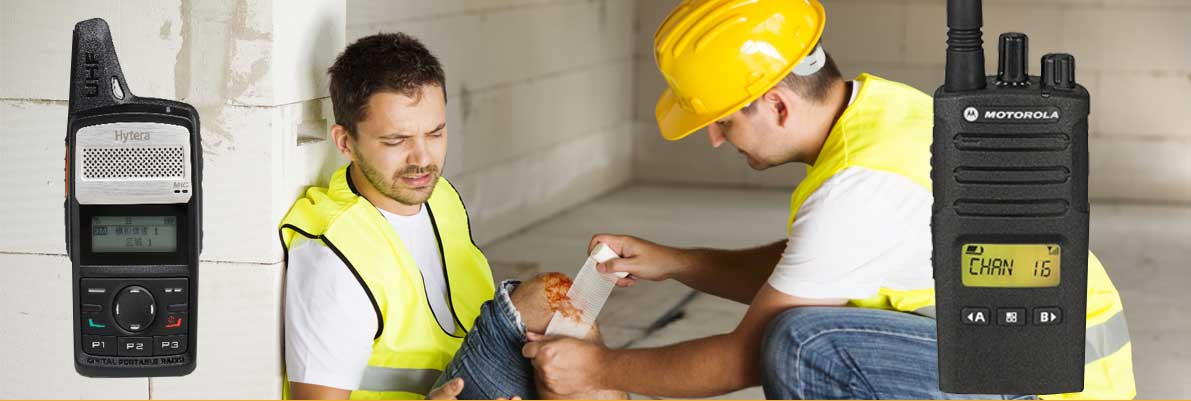
Lone Worker Man Down Two-way Radios
While there are brand after brand of wireless handsets on the market that all claim to be perfect for lone worker use and/or man down protection, in reality some equipment offers less ability than others. And remember that written specifications are one thing, but actual operational benefits outweigh the 'spin' that sometimes some wireless radio manufacturers present. While the lone worker and man down solutions are catered for, the optional GPS can greatly enhance the lone worker and man down ability in any emergency. So choosing a handset that has GPS tracking and a number of other things like geofencing might be exactly what you need, but only a customer can really determine what is or is not suitable because customers KNOW the exact usage of the equipment that will be best suited for features/use match.
There are so many companies writing about this general subject on the internet today, but factually, it is ALWAYS best speaking to experts within a company that you can trust to be unbiased and who offer a good warranty and a fair price. The subject of communications can be a very technical subject, involving radio networks and other technologies and if safety is involved my recommendations are that you speak to professionals that have a proven track record.
This article is written by A B McKenzie, of Long Range Systems UK and independent reviewer of vertical technology products from a number of sectors. (c) Long Range Systems UK Ltd 2026. All Rights Reserved.