03 July 2026 | LaserUser.com
The Growing Challenge of Supporting Ageing Laser Systems
Many laser systems remain productive long after their original expected service life.
It is not unusual for us to speak with customers who are running machines that are 10, 15 or even 20 years old. In many cases these systems continue to produce excellent results and remain an important part of the business. Schools, colleges, engineering companies, sign makers, jewellers and manufacturers often have equipment that is still perfectly capable of doing the job it was purchased for.
The challenge is that as machines get older, obtaining support can become increasingly difficult.
Manufacturers naturally focus their efforts on current product ranges and newer technologies. Over time, spare parts may become harder to source, software compatibility can become an issue, and technical knowledge relating to older equipment gradually disappears.
We regularly receive enquiries from users of older GCC, Epilog, Universal Laser Systems, Boxford, HPC, Lotus and other laser systems who are trying to keep reliable equipment operating efficiently. Often the problem is not a major failure. It may simply be identifying the correct lens, mirror, motor, power supply, controller or cable required to return a machine to service.
In the education sector particularly, budgets are under increasing pressure. Replacing an entire laser system is not always practical when a relatively small repair or upgrade can provide several more years of useful service.
At the same time, there is growing recognition that extending the life of existing equipment makes both economic and environmental sense. A well-maintained laser system can often continue operating productively for many years beyond its original warranty period.
One of the biggest changes we have seen over recent years is the increasing importance of independent technical resources. Users are no longer relying solely on manufacturers for information. Online communities, forums, technical articles and specialist suppliers now play an important role in helping owners troubleshoot faults, identify compatible parts and make informed decisions about maintenance and upgrades.
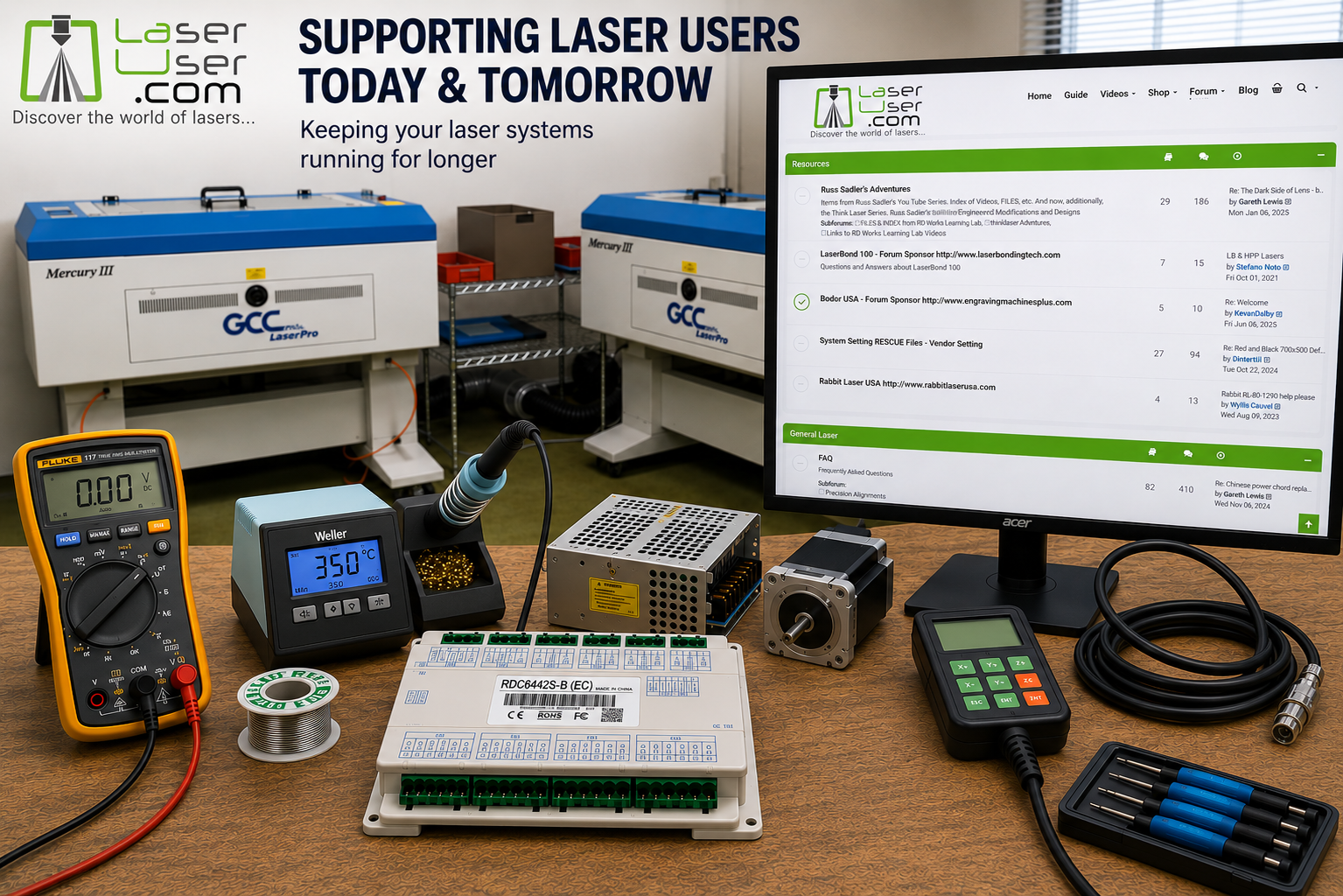
A good example is the continued growth of the LaserUser Forum (forum.laseruser.com), which originally began life as RDWorksLab. What started as a resource primarily focused on Ruida controller users has developed into a wider community covering laser cutting, engraving, maintenance, software, optics, machine upgrades and troubleshooting across a broad range of laser systems.
Many users of Ruida-based machines, particularly those operating generic Chinese laser systems, find themselves relying on community knowledge and shared experience to solve technical issues that would otherwise be difficult to diagnose. In many cases, advice shared by experienced users can help identify faults, improve machine performance or avoid unnecessary replacement of expensive components.
The laser industry has always been innovative, but there is also significant value in preserving and supporting the large installed base of existing equipment. For many organisations, keeping a proven machine operating reliably can deliver a better return on investment than replacing it simply because it has reached a certain age.
As laser technology continues to evolve, we believe there will be an increasing need for practical technical support, accessible information and specialist knowledge to help users get the maximum value from their equipment throughout its entire working life.
At LaserUser.com, we see this every day. Whether it is helping identify a replacement optic, sourcing a hard-to-find component, providing technical guidance or directing users towards community resources such as the LaserUser Forum, supporting existing laser users remains just as important as supporting the latest generation of machines.
For many laser owners, a reliable source of information can be just as valuable as the parts themselves.