23 November 2026 | Mammoth Attachments
Fitting a Forklift Attachment? Check What Your Truck Can Really Lift
The capacity on a forklift's data plate only holds at the load centre shown on it. Fit an attachment and the safe figure drops, sometimes sharply.
The load centre is the distance from the face of the forks to the load's centre of gravity. Most counterbalance forklifts in the UK are rated at 500mm, and larger trucks often at 600mm. An evenly loaded pallet 1,000mm deep, pushed back against the fork heels, puts it at 500mm. The same load on a pallet 1,200mm deep puts it at 600mm, beyond a 500mm rating before anything is fitted.
Why attachments cut capacity
A counterbalance forklift works like a see-saw, with the front axle as the pivot: the further out the load sits, the more leverage it has. An attachment works against you twice: its own weight sits in front of the axle and uses up capacity before you've lifted anything, and most attachments carry the load further out than bare forks, whether that's a long load on fork extensions, a hook on a jib or a pallet on a rotator.
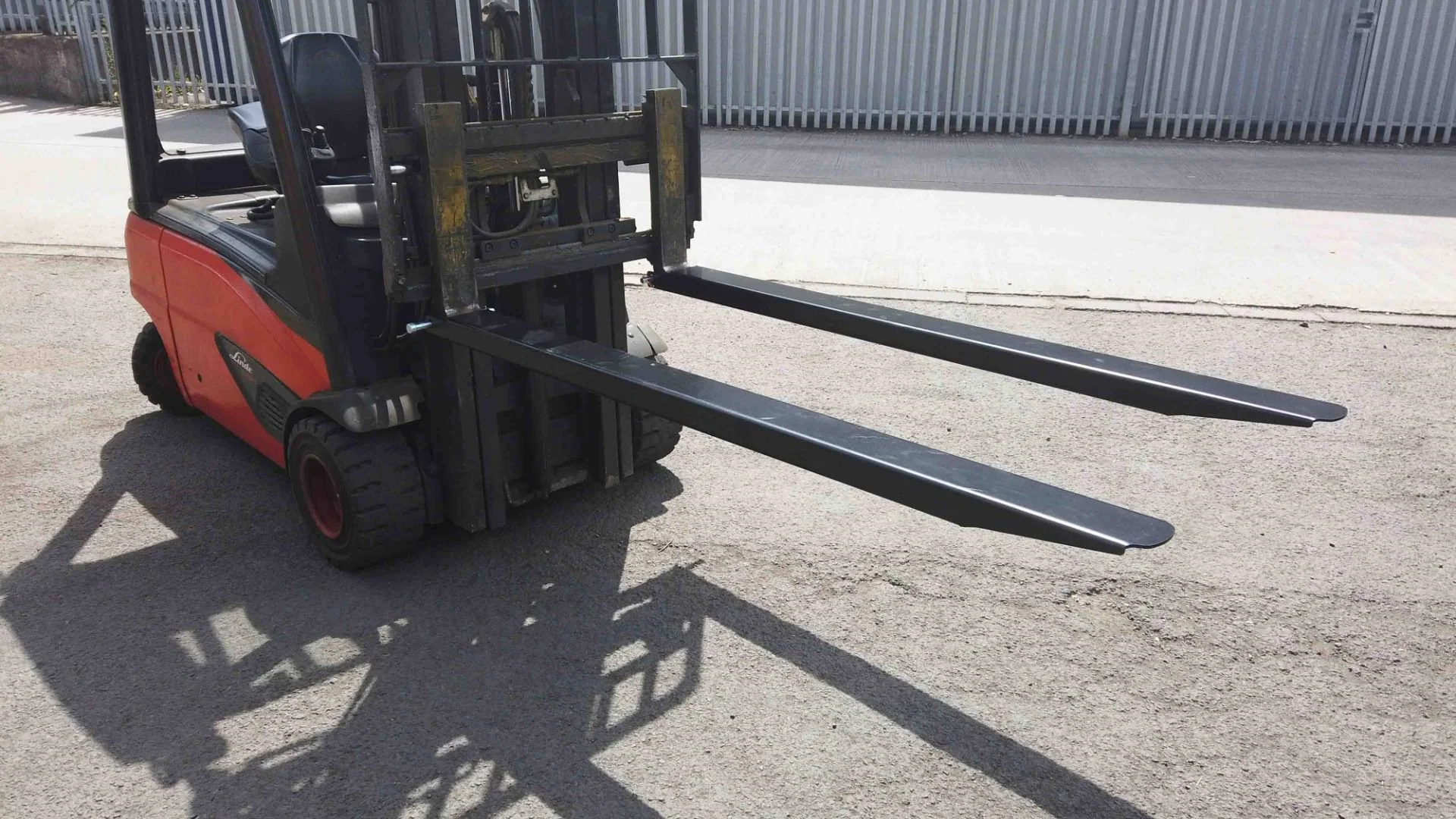
The capacity marked on an attachment is its own rating, not the truck's. Fork extensions rated at 3,000kg don't make a 2,500kg truck a 3,000kg truck, and with a long load on them it will lift well under 2,500kg.
A worked example
Take a pallet rotator rated at 500kg that weighs 187kg and carries the pallet at a 1,890mm load centre. On a 2,500kg truck rated at 500mm, a quick estimate gives 2,500 × 500 ÷ 1,890 = 661kg for the rotator and pallet together. Take off the rotator's 187kg and 474kg is left for the load: not 500kg, and certainly not 2,500kg.
A quick check before you buy
- Read your data plate for the rated capacity and the load centre it applies at.
- Measure the new load centre to where the load's weight will sit. If in doubt, measure further out.
- Multiply the rated capacity by the rated load centre, divide by the new load centre, then take off the attachment's weight.
- Your limit is the lower of that figure and the attachment's own rating.
Treat the result as a planning figure, not a rating: it ignores lift height, mast tilt and the truck's condition. HSE's warehousing guidance, HSG76, says de-rating a truck for an attachment should be done by the manufacturer or an authorised dealer, and that the truck needs a rating plate showing its capacity with that attachment fitted. If you swap between attachments, you need a figure for each one.
Our full guide to forklift load centres also covers lift height and what your dealer will ask for when de-rating your truck. If you'd like us to check an attachment against your truck, request a quote with its capacity, load centre and fork sizes and we'll come back to you.