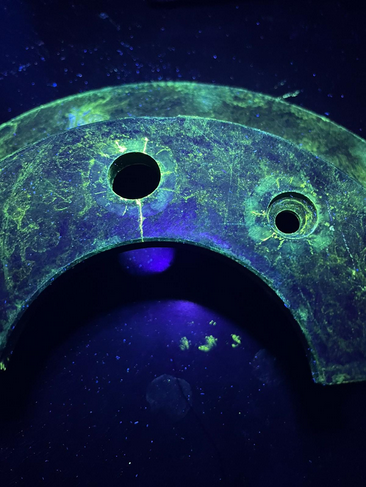
Dye Penetrant Inspection
Dye Penetrant inspections continue to be an effective and reliable inspection method for components such as; castings, forgings, machined parts and welds.
The two main Dye Penetrant Inspection methods we carry out are;
Colour Contrast Penetrant Inspection - Used for site work. Portable equipment. Very versatile. Good value. Great results.
Fluorescent Penetrant Inspection - Workshop based. Fixed equipment. Very high sensitivity. Great for large components.
All of our experienced inspectors are level 2 certified by the British Institute of Non-Destructive Testing.
Inspection Standard - BS EN ISO 3452-1:2013
Other Products and Services from WHE NDT
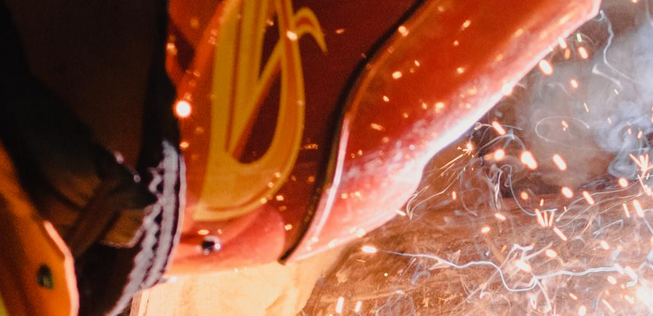
Welding Services
Some previous projects include;
Southbay Civil Engineering - Ridham Dock - Ground piles with sample extraction.
Total Lifting Solutions - Canadian Embassy - Heavy duty automotive lift repairs.
Heathrow Cranes - Jib repairs.
EG Martin - 60,000L Tank - Weld repairs.

Weld Procedures & Welder Qualifications
Weld Procedure Specification is the formally written document which provides the welding party with the necessary information for the scope of work they have. This preliminary document is normally provided by the manufacturer, along with test pieces from each welder.
Weld Procedure Approval
Weld Procedure Approval is the next step in the process, whereby the preliminary procedure is reviewed and approved by the inspection body. The approved procedure will come as part of the Weld Procedure Approval Record.
WHE NDT are willing and able to provide this service at your request.
Welder Qualification
Welder Qualification is the final step, using test pieces provided by each welder. The welded components are inspected and tested by various NDT methods, alongside destructive mechanical tests.
We travel to our clients, working around your schedules, offering an efficient and great value service.

Hardness Testing
WHE NDT are able to give a measurement in Leeb (HL), Brinell (HB), Vickers (HV) or Rockwell (HRA, HRB, HRC).
This test can be carried out on a wide variety of materials. Our operators are able to carry out this service on site or at our test facility.
If you require any further information, please do not hesitate to contact info@whendt.co.uk.

WHE NDT
18 Reading Arch Road, Redhill, Surrey, RH11HG, United Kingdom
At WHE NDT, we specialise in Non-Destructive Testing (NDT), weld procedures, and welder qualifications, offering a wide range of inspection techniques across the UK for various industries. Our services include Magnetic Particle Inspection, Ultrasonic Weld Inspection, Phased Array UT, Penetrant Inspection, District Heating Inspection, Structural Steel Inspection, Pressure Vessel & Tank Inspection, and Crane NDT Inspection. We are dedicated to providing efficient, reliable, and value-driven NDT services tailored to your business needs. Serving sectors such as Defence, Aerospace, Power Generation, Construction, Rail, Fabrication, Engineering, and Manufacturing, our technicians hold Level 2 PCN or CSWIP qualifications (ISO 9712) and Level 3 qualifications, backed by 24 years of combined experience. Unsure about your requirements? We ensure a hassle-free service to meet all your needs.