12 August 2025 | The Green Office
Greenery and Group Work: How Plants Encourage Collaboration in Offices
When we think about collaboration, we often picture meetings, whiteboards, software platforms, and team-building sessions that get pencilled in but quietly dreaded. What we don’t always picture is something leafy, rooted, and quietly transformative.
But here’s the thing. One of the simplest, most underrated ways to increase better connection between colleagues isn’t a new system or a shiny tool. It’s greenery.
Yes. Real plants. The sort with stems, leaves, and a life of their own.
Not for decoration. Not to tick a sustainability box. But because the presence of plants in the workplace is increasingly being linked with stronger teams, better communication, and more natural collaboration. And in a time when companies are trying to balance hybrid schedules with team cohesion, when creativity is in high demand but time together is short, that matters.
Because collaboration is no longer just a nice to have. It’s a competitive advantage.
Why Greenery Works: The Science of Social Spaces
Let’s start with the science. The term biophilia refers to our innate human instinct to connect with nature. It’s not just poetic. It’s physiological. We are calmer in green spaces. We recover faster. We concentrate more easily. We feel safer.
In the office, this translates into a shift in mindset. Less stress. More openness. And with that, more collaboration. Not forced collaboration, but the sort that happens organically, when people feel comfortable in their space and safe in each other’s company.
In fact, researchers at the University of Exeter found that even just adding a few indoor plants to a barren office increased productivity by 15 percent. And while productivity is one thing, the knock-on effect on communication and morale was just as valuable. People reported feeling more engaged, more enthusiastic, and more inclined to contribute.
Collaboration doesn’t start in a meeting room. It starts in the conditions we create before we ever speak.
The Power of Presence: Why Mood and Environment Matter
It’s easy to forget how much the environment shapes behaviour. Cold, clinical spaces can make people retreat into themselves. Stark lighting, grey tones, and the constant hum of artificiality create tension before a single word is said.
Greenery changes that. It softens the mood. It encourages people to linger. It makes a space feel less transactional and more relational.
Studies have shown that plants reduce tension and anxiety by over a third. That’s not just helpful for individuals. It’s a benefit for entire teams. When people are less anxious, they are more likely to speak up, to offer ideas, to ask for input. All of these are building blocks for good collaboration.
And it goes deeper. When people feel comfortable, their body language opens up. They face each other more often. They make better eye contact. These subtle shifts can completely change the dynamic of a team. And they start with something as simple as a bit of foliage.
Natural Conversation Starters: Plants as Social Catalysts
We often underestimate the role that design plays in prompting human behaviour. We think of desks and chairs and lighting as neutral. But everything in a space sends a message.
Plants are one of the few features that consistently invite connection.
They act as social catalysts. People comment on them. They share care tips. They joke about the office cactus or name the plant in the corner. It’s small talk, yes. But that’s exactly the point. Small talk leads to rapport. Rapport leads to trust. And trust is what allows people to work together effectively.
In one study from the Netherlands, teams working in a plant-filled environment reported not only higher satisfaction with their work, but also more positive feelings toward their colleagues. A living wall, a well-placed planter, even a hanging fern above the printer become cues that signal care, welcome, and warmth.
Healthier People, Healthier Teams
We all know the impact of sick days and low energy on team performance. What’s often overlooked is the way indoor plants help reduce those issues.
It’s not just about air purification, although studies have shown that some common plants can reduce toxins and improve air quality. It’s also about humidity, oxygen, and that subtle sense of freshness that lifts a room.
A healthier environment means fewer headaches. Less fatigue. Better skin. Fewer coughs and sniffles. And while one plant won’t perform miracles, a thoughtfully planted space contributes to a workplace where people feel better physically and mentally. And when people feel better, they show up better. They collaborate more readily. They contribute more consistently.
In an age of high expectations and fast-paced projects, that’s no small thing.
Noise, Focus, and Fluid Zones
Open plan offices were once hailed as the future of teamwork. But as anyone who’s tried to concentrate next to a video call can attest, they have their flaws.
This is another area where plants offer quiet genius. Quite literally.
Plants absorb sound. Tall, leafy varieties like fiddle leaf figs or palms can significantly reduce background noise, especially when placed near hard surfaces or between zones. Moss walls, in particular, are being used to create soft acoustic barriers in collaborative zones. They reduce echo, muffle conversation spillover, and bring a natural sense of boundary without needing physical walls.
The result? People can focus more easily. And when they do come together, the space supports clear, constructive communication.
Greenery as a Culture Statement
More than anything, plants in the workplace send a message.
They say, we value this space. We care about how it feels to work here. We are building something together, not just getting through the day.
And when that message is consistent, when it’s reflected in the break room, the meeting area, the reception and the shared kitchen, it becomes part of the culture. People notice. Clients notice. New hires notice.
Greenery communicates thoughtfulness. And thoughtfulness fosters the kind of environment where collaboration is not mandated, but modelled.
Practical Ways to Plant Collaboration
If you’re looking to use greenery to enhance teamwork in your office, here are some practical starting points:
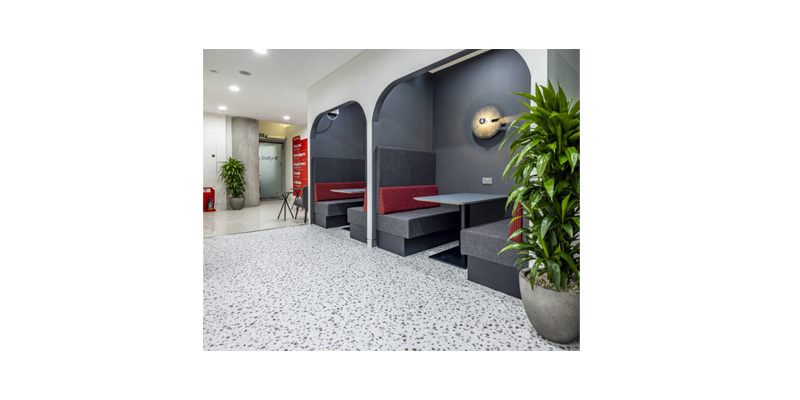
1. Think beyond the desk plant.Use greenery to shape the space. Create informal meeting spots. Break up large areas. Frame corners where conversations happen naturally.
2. Focus on communal areas.Kitchens, breakout zones, and corridors are ideal places for greenery to soften transitions and spark interaction.
3. Involve the team.Let people choose their desk plants or name the larger ones. Shared ownership increases engagement and builds subtle connection.
4. Use greenery as a design feature.Living walls, hanging planters, or shelf-edge foliage can enhance the aesthetic and create a cohesive, welcoming vibe.
5. Match plants to purpose.Choose species that suit the light, space, and care capacity of your team. Hardy favourites like pothos, snake plants, and peace lilies offer great visual return with low maintenance.
Final Thought: The Quiet Power of the Living Office
We spend a third of our lives at work. And increasingly, we understand that the quality of that experience shapes everything – from our health to our happiness to the quality of the work we do.
Greenery may not shout for attention. It doesn’t demand a budget like a fit-out or a software suite. But its impact is deeply felt.
Because in a space that feels alive, people come alive. They talk more. They share more. They feel more human.
And in the end, that’s what good collaboration is really built on.