12 December 2025 | St Clare Engineering
Choosing the right forklift attachment for safe whisky cask handling
A practical guide to choosing safe and reliable forklift attachments for moving whisky casks throughout production, storage and bottling
Moving casks is a routine part of whisky production, from filling through to maturation, disgorging and export. Each stage involves heavy, liquid-filled vessels that must be managed with precision to avoid product loss, damaged stock and safety risks. The right forklift attachment allows teams to move casks securely, reduce manual handling and keep operations running efficiently.
St Clare Engineering supplies drum, barrel and cask handling equipment across the world, including to famous whisky-producing and distribution companies in Scotland, Ireland and the USA. This guide sets out the key handling requirements at each stage of whisky production and explains how different attachments support safe, controlled movement.
You can also view our full range of drum and cask handling equipment for more detail.
Understanding the containers used in whisky production
Whisky is matured in a range of wooden vessels. Each varies in size, weight and handling behaviour when full or empty. Although ‘cask’ is the broad industry term used throughout Scotland and Ireland, American producers commonly refer to ‘barrels’. St Clare Engineering provides drum handling equipment suitable for all types of drum, including wooden casks and barrels.
For context, whisky production regulations in Scotland require maturation in wooden casks under Scotch Whisky Association guidance, while Ireland follows standards established by the Irish Whiskey Association. American whiskey operations follow regulations set by the alcohol Tax and Trade Bureau TTB.
A detailed explanation of the various types of drums used in container types can be found in this overview of whisky cask sizes and this technical article on barrels vs casks.
Key challenges when handling whisky casks
Distilleries, bottling plants and warehouses handle thousands of casks each year. Challenges for teams managing these valuable loads include:
- Weight: Full casks can exceed 250 kg depending on fill level.
- Shape: Rounded sides and rolling tendency make them difficult to control manually.
- Liquid movement: Sloshing increases momentum when lifting or rotating.
- Risk of damage: Strengthening structures such as staves, chimes and hoops can be weakened if dropped or stressed.
- Space constraints: Traditional bonded warehouses often have narrow aisles and uneven floors.
- Repetitive manual handling: Increased operator strain and safety risks, highlighted in HSE’s manual handling guidance.
Forklift truck attachments designed for handling casks minimise these risks and support consistent, repeatable movement.
Choosing the right attachment for each stage of whisky handling
Like many operations to move drums containing liquids, the safe handling of whisky casks or barrels poses a range of operational requirements at different stages of production.
Filling, initial handling and moving casks into warehousing for maturation
- Unloading from lorries or containers
- Positioning empty casks under filling lines
- Securing casks during filling
- Transporting full casks to storage
- Navigating tight spaces
- Keeping heavy loads secure on uneven floors
Sampling, rotation and management during maturation
- Accessing casks for routine checks
- Rotating casks as required
- Moving selected batches for blending
Emptying and preparation for bottling
- Controlled tipping
- Handling fragile older casks
- Maintaining consistent flow into vats
Recycling, repurposing and export
- Moving and loading casks for cooperage work
- Preparing vessels for resale or shipment
- Handling older vessels with structural wear
St Clare Engineering manufactures a wide range of drum handling forklift attachments to help at every stage of the whisky production process:
Recommended attachments: wine and whisky barrel handler
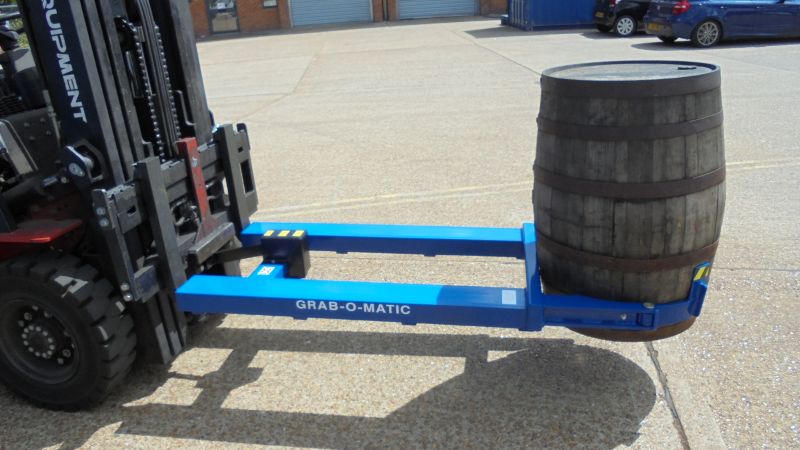
St Clare Engineering’s barrel handler is a fork-attachment Base Gripper which automatically grabs the base of the cask, while gripping arms close around the body of the cask as it is raised to provide stability. To release the barrel, the forklift operator simply places the barrel down and reverses, initiating automatic release.
Recommended attachments: Grab O Matic quick attach and release systemThe barrel-handling forklift attachments can be fitted to the truck using our standard T-bolt system or the optional chain-and-clamp fixing. For operations where attachments are changed frequently — especially in production areas where pallet movement is also required — we recommend the Quick Attach/Release System. This provides a secure, automated locking mechanism that allows fast, reliable attachment changes with minimal interruption to workflow
Recommended attachments: Drum Rotators
If you need to lift and rotate casks or barrels end over end, we can provide controlled manual rotation suitable for sampling, mixing and repositioning tasks. Our Whisky Barrel Fork Attachment Rotator uses a bespoke clamping system to hold each barrel securely during lifting and rotation, and can be specified to suit the size and type of cask or barrel used in your operation.
Factors to consider when selecting cask handling equipment
- Cask type and size
- Frequency of handling
- Warehouse layout
- Safety and compliance requirements
- Operator skill
- Need for powered or manual attachments
Our experts are always happy to help you choose the correct drum handling equipment for your drums, wooden casks and barrels. We have experience in supplying drum handling equipment for a wide range of industries and applications, so if you are not sure what you need, or have specialist requirements, please let us know.
Why distilleries in Scotland, Ireland and the USA choose St Clare Engineering
Distilleries and bonded warehouses work in demanding environments where safe, repeatable handling matters. Our equipment is designed to support these conditions and is used across whisky operations of all sizes.
- Built for heavy, liquid-filled loads
Our attachments are engineered to manage the weight and movement of full casks, providing stable and predictable handling. - Proven performance in real-world distillery settings
We supply equipment to a wide range of facilities, from small craft producers to high-throughput bonded warehouses. - Compatible with all common cask types
Our handling attachments support barrels, hogsheads, butts, puncheons and industrial drums used across Scotland, Ireland and the USA. - Reliable in challenging warehouse environments
Attachments are designed to perform on wet floors, uneven surfaces and in confined aisles typical of traditional maturation warehouses. - Established export capability
We ship regularly to whisky producers in Scotland, Ireland and the USA, with equipment configured to local operating conditions and handling preferences.
If you would like guidance on selecting the most suitable attachment for your workflow, our team is available to help.Contact us for advice or a no-obligation quotation.
FAQs
1. What is the best forklift attachment for handling whisky casks?
The best attachment depends on the task. Our wine and whisky barrel handler is purpose built for handling whisky casks. Drum Rotators provide controlled tipping and disgorging. Distilleries often use more than one attachment to cover all stages of production.
2. Can forklift drum handlers be used for whisky barrels and casks?
Yes. Many drum-handling attachments are designed to grip wooden casks and barrels securely, including ASB barrels, hogsheads and butts. It’s important to choose an attachment with the correct grip mechanism for the cask shape and weight.
3. What safety considerations apply when lifting full whisky casks?
Full casks are heavy, rounded and contain moving liquid, so they require stable, controlled lifting. Operators should use attachments specifically designed for casks, ensure secure engagement before moving, and avoid manual rotation or repositioning. Mechanised handling reduces risk of injury and damage.
4. Do Scottish, Irish and American distilleries use different types of barrels?
Yes. Scottish and Irish producers commonly use casks such as hogsheads, butts and barriques, while American distilleries primarily use 180–200 L American Standard Barrels (ASBs). Forklift attachments should accommodate the full range of shapes and sizes used in each region.
5. What forklift attachment is best for emptying or disgorging whisky casks?
A Drum Rotator is the most suitable attachment for controlled emptying. These units allow operators to tip the cask slowly and accurately, reducing product loss and preventing damage to older, more fragile vessels.
6. How can distilleries reduce cask damage during handling?
Using purpose-built forklift attachments is the most effective way to reduce damage. Secure gripping mechanisms, controlled rotation, and stable lifting all help protect staves, hoops and chimes. This improves cask longevity and reduces losses throughout the maturation process.