04 August 2026 | Active Garden Ltd
Residential vs Commercial Play Equipment: What’s the Difference?
If you’re planning to create an outdoor play area, one of the first questions you’ll need to answer is whether you need residential or commercial play equipment.
At first glance, they can look very similar. Both may feature climbing towers, swings, slides and climbing walls. However, they are designed, tested and certified for very different environments.
Understanding the difference will help you choose the right equipment, keep children safe and ensure your investment lasts for years to come.
What Is Residential Play Equipment?
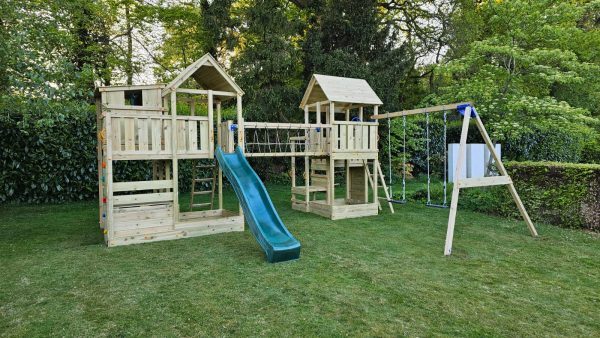
Residential play equipment is designed for use in private gardens by a single household and their invited guests. It is intended for normal family use and is built to provide children with a safe and enjoyable place to play at home.
Examples include:
- Wooden climbing frames
- Swing sets
- Play towers
- Monkey bars
- Sandpits
- Garden playhouses
Residential climbing frames are ideal for families looking to encourage outdoor play while making the most of their garden space.
At Active Garden, our residential ranges include quality timber climbing frames such as our Active Explorer range, Blue Rabbit climbing frames, Adventure Time climbing frames and All Out Play playhouses, designed to provide years of outdoor fun for growing families.
What Is Commercial Play Equipment?
Commercial play equipment is specifically designed for locations where many children use the equipment every day.
Typical commercial locations include:
- Schools
- Nurseries
- Public parks
- Pubs with play areas
- Holiday parks
- Hotels
- Visitor attractions
- Parish councils
- Housing developments
Because commercial equipment experiences much heavier use, it is engineered to withstand higher loads, more frequent play and greater wear over time.
Also, they have extra safety regulations as children might play unattended.
The Biggest Difference: Safety Standards
One of the most important differences between residential and commercial play equipment is the safety standard it is designed to meet.
Residential Equipment
Residential climbing frames are generally designed and tested to comply with EN71, the European safety standard for domestic toys and play equipment.
These standards ensure that equipment is suitable for family use when assembled and maintained according to the manufacturer’s instructions.
Commercial Equipment
Commercial playground equipment is designed to comply with EN1176, a much more demanding safety standard intended for public playgrounds.
Commercial installations also require careful consideration of:
- Fall heights
- Safety surfacing
- Safety zones
- Equipment spacing
- Inspection and maintenance
For this reason, commercial playgrounds are often installed alongside certified safety surfacing such as wetpour rubber, bonded rubber mulch or rubber grass mats, depending on the project requirements.
Built for Different Levels of Use
A family climbing frame may be used by two or three children after school or at weekends.
A school playground or pub play area may be used by hundreds of children every week.
Commercial equipment is therefore designed with:
- Heavier-duty construction
- Larger structural components
- Increased resistance to repeated use
- Long-term durability in busy environments
This makes it suitable for locations where reliability and longevity are essential.
Can Residential Equipment Be Used Commercially?
In most cases, no.
Even if a residential climbing frame appears strong enough, it has not been designed or certified for continuous public use.
If the play area will be accessible to the public, commercial-grade equipment should always be chosen.
Using residential equipment in a commercial setting can have a number of serious consequences, including:
- Failing to meet the relevant safety standards for public play areas.
- Potentially affecting insurance cover if the equipment is used outside its intended purpose.
- Invalidating the manufacturer’s warranty or guarantee, as the equipment is no longer being used in accordance with its intended residential application.
- Increased wear and maintenance due to the much higher levels of use.
- A shorter service life than equipment specifically designed for commercial environments.
- Increased safety risks, as residential equipment has not been designed or certified for continuous public use.
For these reasons, residential play equipment should only be used in private domestic gardens. If the play area is intended for schools, nurseries, pubs, holiday parks, public spaces or any location accessible to the public, commercial playground equipment designed to the appropriate standards should always be selected.
Choosing the Right Timber
Whether you’re buying residential or commercial equipment, the quality of the timber plays a significant role in how the climbing frame performs over time.
Pressure-treated timber helps protect against rot and fungal decay, while accurately machined timber contributes to a stronger, more stable structure and a better overall finish.
Choosing quality materials from the outset often results in lower maintenance and a longer service life.
Key Differences Between Residential and Commercial Play Equipment
Although residential and commercial climbing frames may look similar, there are many important design differences that affect safety, durability and compliance.
Safety Barriers
Commercial climbing frames are generally designed with higher safety barriers and guardrails to help reduce the risk of falls in public play environments, where equipment is used by large numbers of children.
Residential climbing frames are designed to meet the requirements of domestic play while still providing safe and enjoyable outdoor play when assembled and used correctly.
Anchoring the Equipment
Correct installation is essential for both residential and commercial play equipment.
Commercial playground equipment is designed to be permanently installed, with posts securely concreted into the ground in accordance with the manufacturer’s installation instructions.
Our residential climbing frames are supplied with ground anchors and should be installed and anchored in accordance with the manufacturer’s installation instructions. For most models, this includes securing the anchors in concrete to provide a stable and safe installation.
Stronger Components for Commercial Use
Commercial playground equipment is built to withstand significantly higher levels of use.
This often includes:
- Heavier-duty slides designed for frequent public use.
- Stronger swing seats with higher load capacities.
- More robust structural components.
- Heavy-duty fixings and hardware designed for repeated daily use.
Swing Seats and Suspension
Residential swing seats are typically suspended using carabiner-style swing hooks, making it easy to remove or replace swings as children grow or accessories are changed.
Commercial playgrounds normally use permanent anti-vandal swing hangers and chain suspension systems. These are designed to prevent unauthorised removal while providing the strength required for constant public use.
As an example, a typical residential swing seat may have a recommended maximum user weight of around 70 kg, whereas many commercial swing seats are designed for loads of around 100 kg, depending on the specific product and manufacturer.
Residential swing seats generally use ropes of different types, but commercial swing seats use chains, with specific gaps in between the links to not create finger entrapments.
Nets and Rope Components
The climbing ropes and nets used on residential climbing frames are typically manufactured from high-quality polypropylene, polyhemp or braided synthetic rope. These materials are ideal for normal family use, offering excellent durability, a comfortable grip and resistance to outdoor weather conditions.
Commercial playground equipment is designed for much heavier use and different safety requirements. As a result, commercial climbing ropes and nets are typically manufactured with a steel-reinforced core. The internal steel cable provides significantly greater strength and durability, while also making the ropes far more resistant to vandalism and deliberate cutting in public play areas.
This is another example of how commercial playground equipment is engineered for intensive daily use, whereas residential climbing frames are designed specifically for the needs of family gardens.
Timber Dimensions
Commercial playground equipment generally uses larger structural timber sections to cope with higher loads and continuous daily use.
At Active Garden, however, we believe quality is just as important as size. Whether supplying residential or commercial climbing frames, we use high-quality pressure-treated timber designed for long-term outdoor durability, which comes with a 10 year guarantee against rot and infestation and even 15 years guarantee on certain round timber items.
Accessories
Commercial playground accessories are designed with public safety in mind.
Items such as swing seats, climbing ropes and other play components are typically fitted using permanent fixings, with no easily removable parts that could become lost, damaged or misused.
Residential climbing frames offer greater flexibility, allowing accessories to be changed or upgraded as children grow.
Can Commercial Play Equipment Be Used at Home?
Yes. Many families choose commercial-grade play equipment for large gardens, schools at home, farms or multi-generational family spaces.
Commercial equipment offers exceptional durability and is built for intensive use, although it is generally more expensive and often requires more substantial installation.
For most domestic gardens, however, high-quality residential climbing frames provide an excellent balance of safety, durability and value, while still delivering years of outdoor play.
Think About the Future
Before choosing your play equipment, consider how it will be used over the coming years.
Ask yourself:
- Who will use the equipment?
- How many children will be playing on it?
- Will the play area be open to the public?
- Is future expansion important?
- Do you need professional installation?
- What type of safety surfacing is required?
Answering these questions early can help you select equipment that remains suitable as your needs grow.
Why Choose Active Garden?
Since 2004, Active Garden has been helping families, schools, pubs, nurseries and businesses create high-quality outdoor play spaces throughout the UK.
Our team understands both residential and commercial playground equipment and can help you choose the most suitable solution for your location, budget and long-term requirements.
Whether you’re looking for a garden climbing frame for your children or a fully compliant commercial playground for a school or hospitality venue, we’re here to provide practical advice backed by more than 21 years of experience.
Need Help Choosing?
If you’re unsure whether residential or commercial play equipment is right for your project, we’d be happy to help.
Our experienced team can guide you through the options, explain the relevant safety standards and recommend equipment that matches your space, budget and intended use, ensuring you invest in a playground that provides safe, enjoyable outdoor play for many years to come.