11 August 2026 | Meritas Fire & Security Protection Ltd
Passive Fire Protection: The Building Safety Measure Working in the Background
Fire alarms, extinguishers and sprinkler systems are usually the first things people associate with fire safety. They are all important, but they are not the whole strategy. Equally essential is passive fire protection (PFP): the built-in protection that helps limit the consequences of a fire.
Unlike active fire-safety measures, passive protection does not switch on in response to an incident. It is incorporated into the building itself and remains in place at all times. Its purpose is to restrict the movement of fire and smoke, keep evacuation routes safer, and help the structure remain stable. In that sense, it underpins the effectiveness of the wider fire-safety strategy.
Understanding passive fire protection
Passive fire protection covers the systems and materials used to preserve a building’s integrity during a fire and reduce the spread of flames and smoke. It does not rely on electricity, a manual response or a triggering mechanism. Instead, its performance depends on effective design, correct installation and continued maintenance.
Its key aims are to:
- Keep a fire contained within a compartment
- Protect routes used for evacuation
- Slow the risk of structural collapse
- Reduce damage to the property
The main forms of passive protection
Compartmentation
Compartmentation is central to passive fire protection. Buildings are divided into separate fire-resistant areas using walls, floors and ceilings constructed from suitable materials. Should a fire occur, these barriers are intended to contain smoke and flames within one area for a specified period.
This containment gives occupants valuable time to leave safely and enables emergency services to respond more effectively.
Fire doors
Fire doors are a crucial part of maintaining compartmentation. When shut, they form a barrier against smoke and fire, helping to protect corridors, stairwells and other escape routes.
Their performance relies on proper fitting, correct use and routine inspection. A door that is poorly maintained or held open with a wedge can undermine the entire fire strategy of a building.
Fire dampers
Ventilation and air-movement systems are essential in modern buildings, but without suitable safeguards they can provide a rapid route for smoke and fire to travel. Fire dampers are fitted within ductwork to address this risk.
When high temperatures are detected, these dampers are designed to close automatically. This blocks the passage of fire and smoke through ventilation systems and helps preserve the separation between fire compartments.
Protection for structural elements
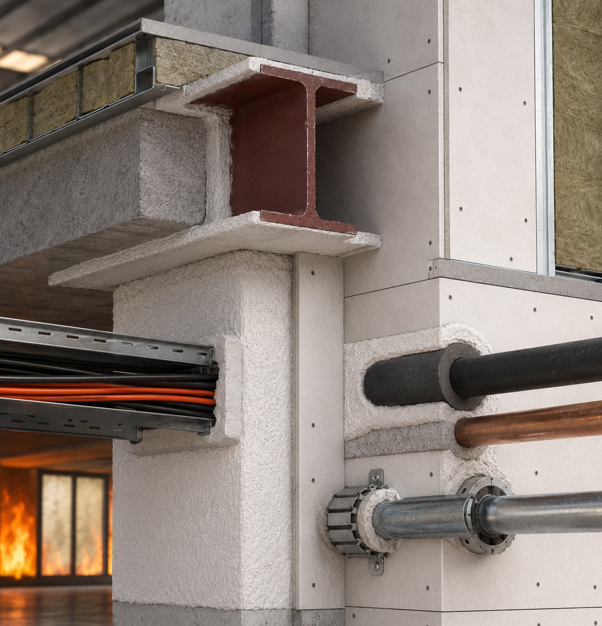
Materials such as steel are strong, but exposure to high temperatures can quickly reduce their load-bearing ability. Structural fire protection is used to insulate building elements and slow the effects of heat.
Methods include intumescent coatings, fire-resistant boards and concrete encasement. By delaying structural failure, these measures help keep the building stable for long enough to support evacuation and firefighting activity.
Fire stopping
Services such as cables, pipes and ducts must pass through walls and floors, creating penetrations that can become routes for fire and smoke if they are not protected. Fire stopping seals these openings with fire-resistant materials, restoring the fire performance of rated walls and floors.
It is a particularly common point of failure, especially where a building has been altered, refurbished or modified.
Why it can be neglected
Passive protection is often hidden inside walls, above ceilings or within structural components. Unlike an alarm or extinguisher, it is less visible in daily building use, making it easier to overlook.
Changes to a building can also compromise its passive fire protection. Examples include:
- New service installations that breach fire compartments
- Gaps or defects caused by poor workmanship
- Deterioration resulting from insufficient maintenance
Without regular checks and competent assessment, these issues may remain undiscovered until an incident occurs.
Looking beyond compliance
Compliance with fire-safety regulations is essential, but an effective approach should be proactive rather than limited to meeting minimum requirements. This includes thorough surveys and inspections, clear identification of risks and non-compliant conditions, high-quality installation or remedial work, and ongoing maintenance supported by documentation.
These steps help ensure that passive fire-protection systems perform as intended if a fire occurs.
An increasingly important safeguard
As buildings become more complex, with mixed uses, integrated systems and changing layouts, passive fire protection becomes even more significant. It offers a permanent, reliable safeguard for occupants and assets alike.
In some circumstances, it can determine whether a fire remains contained or develops into a catastrophic event.
Passive fire protection may be largely unseen, but its value is substantial. By containing fire, safeguarding escape routes and helping preserve structural integrity, it protects both people and property. For building owners, facilities managers and developers, fire safety begins well before an emergency: in the design, installation and maintenance of passive fire-protection systems.