07 October 2026 | Newton Waterproofing
Marine Sheet Pile Waterproofing, Yorkshire
Scarborough Harbour, West Pier
The West Pier in Scarborough Harbour has been subjected to decades of exposure to one of the UK’s harshest marine environments. Over time, the sheet piling had experienced corrosion, movement, and distortion, reducing its durability and requiring a programme of structural strengthening.
Scarborough Council commissioned Neom Engineering to deliver the works, which involved installing a new sheet piling system fixed directly to the existing harbour wall.
The new sheet piles were mechanically fixed to the existing harbour wall. However, decades of tidal movement, corrosion and continual exposure to seawater had caused the original sheet piling to warp and move over time.
The Challenge
The new sheet piles could not sit flush against the existing steelwork, creating numerous irregular voids between the old and new. These voids, and the many joints and interlocks, presented multiple pathways for water ingress.
Previous attempts to seal the structure using conventional grout systems had proved unsuccessful, requiring the project team to develop an innovative alternative solution to deal with the challenging marine environment.
The challenge was further complicated by variations in the seabed profile. Although the new sheet piles were designed to bear directly onto the seabed, differing ground levels created additional voids beneath sections of the piling.
Marine Sheet Pile Waterproofing
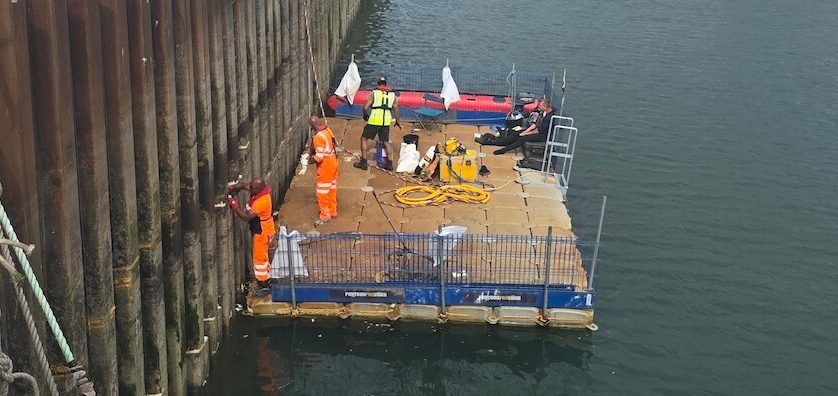
PM Diving Services were appointed to undertake the underwater operations, including the installation and fixing of the new sheet piles, positioning sandbags beneath the piling and supporting the underwater resin injection works.
LCM Environmental provided specialist waterproofing installation, while our expert teams supplied the technical support and specialist injection resin required for the bespoke waterproofing solution.
The project required the sealing of over 100 locations, many between 4 and 6 metres below the quayside. Some of these measured just 15mm, making conventional specialist grout systems impractical and ineffective.
The project therefore required a system capable of:
- Filling irregular voids ranging from approximately 15mm to 50mm
- Sealing the underside of the sheet piling against the uneven seabed profile
- Sealing the gaps between the existing and new piles
- Sealing all joints and interlocks throughout the piling
- Providing a durable waterproof barrier within a constantly submerged marine environment
The Solution – Injection Resin Waterproofing
Technical discussions between LCM Environmental and Newton led to selecting PC Leakinject UNI 6816 E, a high-performance single-component polyurethane injection resin with catalyst from TRADECC.
An extensive programme of testing and on-site trials was undertaken by the project team to refine the installation method.
LCM Environmental, PM Diving Services and Newton collaborated closely to develop the process, optimising the pumping equipment, catalyst ratios and application techniques to suit the demanding conditions.
A key requirement was ensuring the resin could travel approximately 15 metres through delivery hoses before expanding uniformly within the narrow annular voids.
Successful trials confirmed the system’s ability to penetrate complex cavities and create a durable watertight seal.
Installation Method
PM Diving Services first assisted with the installation and fixing of the new sheet piling to the existing harbour wall. Divers positioned sandbags to bridge the gap between the piling and the seabed, providing a stable base while preventing excessive resin loss. A layer of pea shingle was also placed behind the piling as an injection medium.
Working underwater, PM Diving Services supported the installation of the injection system while LCM Environmental carried out the specialist polyurethane injection works. As PC Leakinject UNI 6816 E was injected, the resin travelled through the pea shingle before expanding and bonding with both the aggregate and the sandbags. This created a stable structural base beneath the sheet piling while simultaneously filling the remaining voids.
The resin was then used throughout the structure to seal the irregular gaps between the new and existing sheet piling, together with the joints and interlocks. The result was a continuous waterproof barrier from the seabed through the entire strengthened sheet piling system.
Collaborative Effort
The success of the Scarborough Harbour project demonstrates the importance of collaboration when delivering complex marine engineering solutions.
Neom Engineering coordinated the overall delivery of the project from start to finish.
LCM Environmental provided specialist waterproofing expertise and led the injection works.
PM Diving Services carried out the critical underwater operations. This included assisting with the installation and fixing of the new sheet piling, positioning the support sandbags beneath the piles and supporting the underwater injection process.
Newton Waterproofing supplied the technical expertise, product knowledge and specialist injection resin that enabled the team to develop a bespoke solution where conventional repair methods had proved unsuccessful.
Through close collaboration, extensive testing and innovative engineering, the team successfully delivered a long-term waterproofing solution that will continue to protect this important piece of coastal infrastructure.
The Result
The innovative solution successfully overcame a complex marine waterproofing challenge that conventional repair methods had been unable to resolve. This included:
- Successful completion of approximately 100 underwater repairs
- Effective sealing of annular voids ranging from approximately 15 to 50mm
- Complete sealing beneath the sheet piling and throughout the joints and interlocks of the structure
- Formation of a stable bonded base beneath the new sheet piling through the interaction of the polyurethane resin, pea shingle and support sandbags
- Isolation of the steel sheet piling from seawater and oxygen, reducing the conditions required for further corrosion
- A practical installation methodology that eliminated the need for more complex alternative grouting techniques
- Reduced installation time while maintaining programme requirements
- An extension to the operational lifespan of the strengthened sheet piling system by approximately five years.
The completed works met the client’s expectations and delivered a durable, practical, and cost-effective solution that will help protect Scarborough Harbour’s West Pier for years to come.