14 October 2026 | Klick Technology
The Psychology of Laboratory Design and Scientific Performance
When people picture scientific innovation, they usually picture the people behind it - not the environment where the work actually happens.
Yet in commercial laboratories, the design of the workspace itself has a direct influence on how teams concentrate, collaborate and perform. At Klick, we see laboratories as environments designed around people, not simply technical spaces filled with equipment.
Why Laboratory Layout Shapes Team Performance
Modern laboratories are planned around workflow and function first. Different activities call for different environments, whether that's analytical testing, collaborative write-up spaces, specialist equipment zones or focused technical workstations.
Clear zoning and intuitive layouts can help reduce cognitive overload and support more productive working. In busy laboratories this can mean:
- Smoother movement between laboratory processes
- Improved collaboration between scientific and technical teams
- Safer circulation throughout the workspace
- More efficient use of equipment, utilities and storage
Precision Environments Support Precision Science
Rosalind Franklin's Photo 51 - the X-ray diffraction image that helped unlock the structure of DNA - relied not only on scientific skill but on highly controlled laboratory conditions. Images of her workspaces at Birkbeck and King's College London show how central organisation and technical precision were to her results, a principle that still holds true in today's pharmaceutical, healthcare and research laboratories.
Design Has Moved Beyond Pure Function
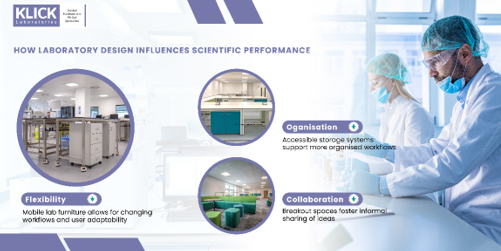
Where laboratories were once built almost entirely around practicality - white walls, uniform surfaces and clinical interiors - modern facilities increasingly incorporate ergonomic workstations, improved lighting to reduce fatigue, collaborative breakout spaces and adaptable layouts built to accommodate future change. Studies into workplace psychology suggest that colour, lighting and materials can affect concentration and comfort over long working hours.
LABORATORY FURNITURE choices, such as standing-height benches and accessible storage systems, shape how people move through and interact with a space every day. Well-lit workspaces with clear sightlines can also help reduce error rates and support safer, more confident working.
Collaboration by Design: Lessons from Bell Labs
Bell Labs, one of the most influential research organisations in history, credited part of its success to deliberately designed breakout and collaboration spaces intended to encourage informal conversation between scientists. The same principle applies today, where interdisciplinary working and knowledge sharing depend on spaces designed to support them.
Case Study – Biofortuna Ltd, Deeside
Klick Technology's LABORATORY CONSTRUCTION and installation project for Biofortuna, a healthcare and diagnostics company in Deeside, is a strong example of how laboratory environments can support workflow and operational performance. The project balanced technical performance, workflow efficiency, durability and future adaptability, integrating specialist furniture, chemical-resistant work surfaces and layouts designed to support both focused technical work and team collaboration.
CLICK HERE FOR THE FULL BIOFORTUNA CASE STUDY
Why Partner with Klick?
With decades of experience delivering LABORATORY DESIGN AND FITOUT projects, Klick Technology understands that successful labs are built around the people who use them, not just the equipment inside them. From research facilities to healthcare and specialist scientific environments, we help clients create practical, high-performing laboratory spaces tailored to their operational needs.
Planning to update your laboratory design? Contact us today on 0161 998 9726 to discuss your project.