26 October 2026 | Sliced Bread Animation Ltd
Gamification in Workplace Learning: Why Participation Matters More Than Points and Badges
Gamification can make workplace learning more engaging, but its value goes far beyond points, badges and rewards. By introducing meaningful challenges, decisions and feedback, organisations can give employees opportunities to practise what they've learned. We explore how gamification works in healthcare, construction and corporate training, with practical examples from Sliced Bread Animation.
Gamification in Workplace Learning: Why Participation Matters More Than Points and Badges
Most organisations invest considerable time and money in employee training, yet getting people to complete a course is only part of the challenge. The more important question is whether they understand the material, remember it and can apply what they've learned when it matters.
Traditional e-learning has made workplace education accessible to large audiences, particularly for organisations delivering training across different locations. However, simply putting information online doesn't automatically make it engaging or effective.
This is where gamification offers a different approach, encouraging learners to become active participants in their education rather than passive recipients of information.
## Gamification Is More Than Points and Badges
Gamification involves applying principles commonly associated with games to activities that aren't necessarily games themselves. In workplace learning, this might include challenges, progression, problem-solving, feedback, rewards or opportunities to explore different outcomes.
Although points, badges and leaderboards are often associated with gamification, they're only a small part of what makes it useful.
The more interesting opportunities come from giving learners a meaningful objective, presenting them with decisions and allowing them to see the consequences of their actions.
Consider a typical workplace compliance course. Employees might be presented with a series of policies, followed by a multiple-choice assessment to confirm they've read and understood the material.
That approach has its place, particularly when information needs to be delivered consistently. But it doesn't always demonstrate whether someone can apply the policy in a realistic situation.
A gamified alternative could present learners with a workplace scenario requiring them to make decisions based on the information they've been given. They might need to identify a potential risk, choose an appropriate response or work through a series of increasingly challenging situations.
The experience becomes more than an exercise in remembering information. Learners are encouraged to think about how they would use that knowledge in practice.
Turning Everyday Learning into an Interactive Challenge
One of the strengths of gamification is that it can make familiar or routine subjects more interesting without losing sight of their educational purpose.
At Sliced Bread Animation, we've applied this approach to environmental awareness and waste management.
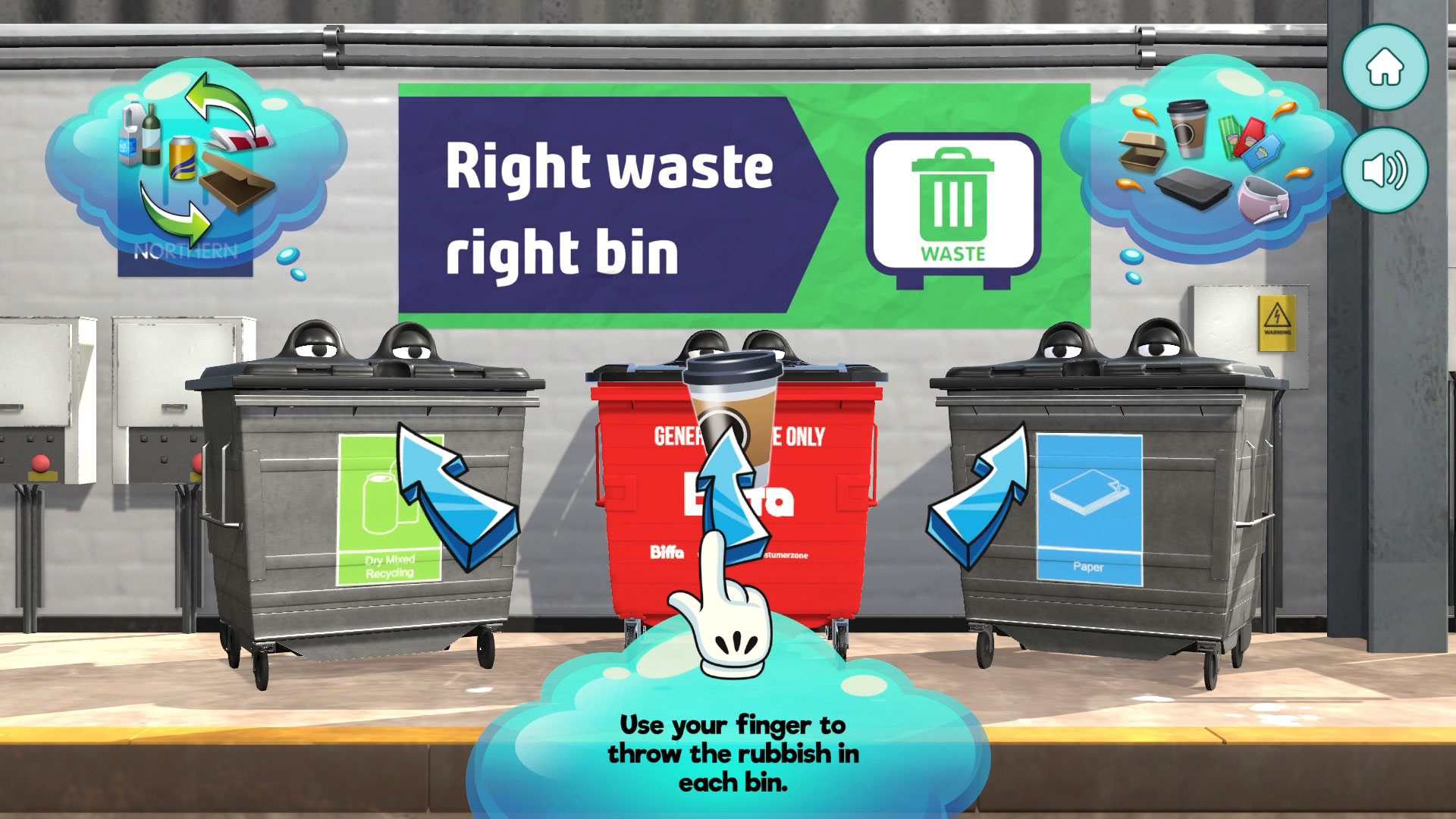
For waste management company Biffa, we developed an interactive game that challenged players to sort different types of waste correctly. Rather than simply presenting information about recycling and waste disposal, the experience invited players to make decisions and receive feedback through gameplay.
The concept was subsequently adapted for Northern Rail, helping employees learn about handling different waste streams within their working environment.
These projects demonstrate that gamification doesn't have to involve building an elaborate video game. A relatively simple challenge, designed around a clear objective, can create an opportunity for people to engage with information in a different way.
The important consideration is what the learner takes away from the experience and whether the activity supports something they need to understand or do.
Gamification in Healthcare and Regulated Industries
In healthcare, pharmaceuticals, construction and engineering, training often involves complex information and decisions that can have significant consequences.
These industries also need to demonstrate that employees understand important procedures, policies and responsibilities.
Gamification can help by creating opportunities to explore situations that would be difficult or inappropriate to recreate in real life.
Healthcare professionals might work through communication scenarios, construction employees could identify hazards in a simulated environment, or pharmaceutical employees might navigate ethical and compliance decisions.
The technology doesn't necessarily need to be complicated. A carefully designed interactive scenario delivered through a browser can provide a valuable learning experience without requiring specialist equipment.
In pharmaceutical learning, we've developed gamified e-learning incorporating interactive challenges, exploratory navigation and decision-making to help employees engage with complex organisational policies.
Rather than simply asking learners to read information and confirm their understanding, these approaches can encourage them to consider how policies relate to situations they might encounter in their work.
The Importance of Feedback and Progression
A good game gives players a reason to continue. They understand what they're trying to achieve, can see how they're progressing and receive feedback that helps them improve.
These same principles can be useful in workplace learning.
Progression might involve completing increasingly challenging scenarios, developing confidence in a particular skill or working towards a clearly defined objective.
Feedback is especially important. Learners should understand why a decision was appropriate, what could have been done differently and how that knowledge relates to their work.
Simply telling someone that an answer is incorrect doesn't necessarily help them improve. Explaining the consequences of their decision, or giving them another opportunity to approach the situation differently, can make the experience more meaningful.
This is particularly relevant when the objective involves developing judgement, communication or problem-solving skills rather than memorising information.
Where Gamification Meets Immersive Learning and AI
Gamification also sits comfortably alongside other developments in digital education.
Scenario-based e-learning can incorporate progression, challenges and feedback. Augmented Reality can introduce interactive activities into physical environments, while immersive simulations can allow learners to practise tasks and respond to realistic situations.
AI-powered characters introduce another possibility, enabling learners to practise conversations through natural dialogue rather than choosing from predetermined responses.
For example, a manager might be given the objective of helping a disengaged employee work towards a particular goal. They can explore different approaches through conversation, receive feedback and try again.
The experience can incorporate game-like elements such as objectives, progression and evaluation, but the activity itself remains grounded in a realistic workplace situation.
These approaches share a common principle: learners become involved in the experience and have opportunities to make decisions, practise skills and reflect on their performance.
Importantly, none of this means that every training programme needs to become a game, or that immersive learning automatically requires a VR headset.
Sometimes a simple interactive challenge is all that's needed to make a subject more accessible.
Designing Around the Learning Objective
One of the most important considerations when introducing gamification is understanding what the learner needs to achieve.
Adding points or rewards to an existing course might make it more entertaining, but it won't necessarily improve understanding.
Effective learning design starts by identifying the knowledge, skills or behaviours the organisation wants to develop.
From there, game mechanics can be introduced where they support those objectives.
If learners need to recognise hazards, a challenge involving identifying and responding to risks might be appropriate. If they need to develop communication skills, branching scenarios or AI-powered role-play could offer opportunities to practise.
The level of complexity should reflect the learning objective, the audience and the environment in which the training will be delivered.
Measuring What Matters
Gamified learning can provide organisations with useful information about how people interact with training.
Alongside traditional measures such as course completion, organisations can examine decisions made during scenarios, repeated attempts, common mistakes and areas where learners struggle.
This can help learning and development teams identify where additional support may be needed.
Of course, interaction data alone doesn't prove that workplace behaviour has changed. Meaningful evaluation should connect learning performance with the objectives established at the beginning of the project.
Learning by Doing
The growing interest in gamification reflects a wider change in how organisations approach digital education.
Rather than concentrating exclusively on delivering information, learning designers are looking at how people can participate, practise and apply their knowledge.
For organisations dealing with complex subjects, technical processes or regulated environments, this creates opportunities to make training more relevant to the situations employees encounter.
At Sliced Bread Animation, our approach is to start with what people need to understand or do differently, then use the right combination of learning design, creativity and technology to support that objective.
Whether that involves gamified e-learning, interactive scenarios, immersive experiences or AI-powered conversations, the principle remains the same.
We call it learning by doing.