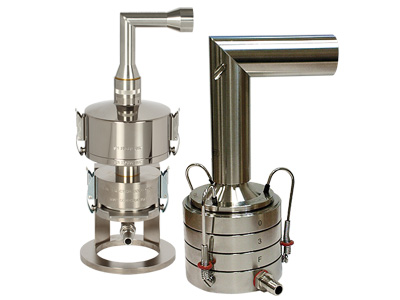
Abbreviated Impactor Measurement (AIM) Equipment
Using an AIM methodology for early stage development has become increasingly popular as both OINDP device and drug companies look for ways to shorten drug development. This technology has traditionally been limited to early development signals indicating rough drug particle size, and this equipment is still intended to categorize the entire dosage for effective mass balance exercises.
Other Products and Services from TSI Instruments Ltd
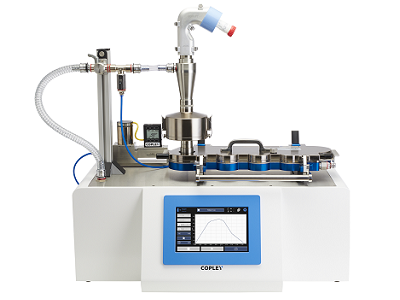
In Vitro − In Vivo correlation IVIVC Equipment
A basic system is comprised of two more-realistic elements to give a more accurate representation of how a drug may behave in a specific type of patient’s respiratory system: the first is a more anatomically representative mouth and throat feature, and the second is a more representative breathing pattern.
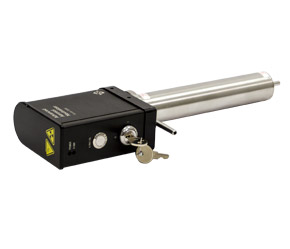
Aerosol-Neutralizers
Normally, a high level of electrical charge is undesirable because it increases the particle loss to the walls of transport and sampling systems, or it can affect filter-efficiency measurements.
To ensure that instruments operating on the electrical mobility principle work properly, aerosol particles entering these instruments require an aerosol neutralizer to impart a predictable charge distribution to the aerosol particles.
Neutralizers can be separated into two categories based on how they charge the particles. One group is the radioactive neutralizers, which use the emission of alpha (positive) or beta (negative) particles from decaying radioactive elements to impart charge to the particles. The other group is the non-radioactive neutralizers, which use electricity to generate x-rays or produce high voltages that can charge the particles directly.

OmniTrak Air Quality Meter
Customizable, Scalable, and Affordable Solutions from TSI.
TSI provides a modular designed solution allowing for flexibility and connection to future generation modules for additional surveying capabilities. All connected to our OmniTrak™ Smart Station, each individual module can be wirelessly connected for different testing parameters (up to 10 at a time).
Tailor the solution to fit your needs. Whatever role you take on from industrial hygenist, facility manager, property owner, or a leader in education, indoor environments vary between every building and room. TSI OmniTrak™ Solutions help air quality testing professionals who want to survey various air quality parameters with multiple measurement points and analyze data inputs to create reports by reducing the number of survey instruments needed and avoiding time-consuming manual work to increase their productivity.
Are you tired of spending hours creating reports manually? Enjoy custom reports and smart visualization in a few clicks with TSI Link™ Report Creator. Save time and simplify reporting - with TSI Link™ Report Creator you can automatically generate custom reports that include tables, graphs, additional insights and access user-friendly Excel templates for your studies.
Available modules: Ammonia (NH3), Chlorine (Cl), Ozone (O3), Formaldehyde (HCHO), Carbon Monoxide (CO), Particulate Matter (PM) and VOC-PID (ppm), VOC-PID (ppb), VOC-PID (ppm), Particulate Matter (pm)

TSI Instruments Ltd
Stirling Road, Cressex Business Park, High Wycombe, Buckinghamshire, HP12 3ST, United Kingdom
TSI Ltd serves a global market by investigating, identifying & solving measurement problems. As an industry leader in the design & production of precision measurement instruments, TSI partners with research institutions & customers around the world to set the standard for measurements relating to Respirator Fit Testing, aerosol science, air flow, indoor air quality, fluid dynamics and biohazard detection. With headquarters based in the U.S. & field offices throughout Europe & Asia, TSI has established a worldwide presence in the markets we serve.