22 August 2025 | Catering Equipment Ltd
Food Labeling in Commercial Kitchens: A Simple System for Safety, Waste Reduction, and FDA Compliance
In a busy commercial kitchen, food labelling is one of the most effective tools for maintaining food safety, reducing waste, and staying compliant with FDA regulations. While digital systems are gaining popularity, many kitchens still rely on manual labelling methods for their simplicity, flexibility, and cost-effectiveness.
Food labels play a critical role in organising stock, preventing cross-contamination, and ensuring that food is used before it expires. By clearly marking containers with essential information, kitchen staff can quickly identify products and follow safe food handling practices.
FDA compliance is a key reason to implement a robust labelling system. The FDA requires that food items be labelled with their common name, preparation date, and expiration date, especially in environments where food is stored, prepped, and served for perishable items like meats, dairy, and seafood.
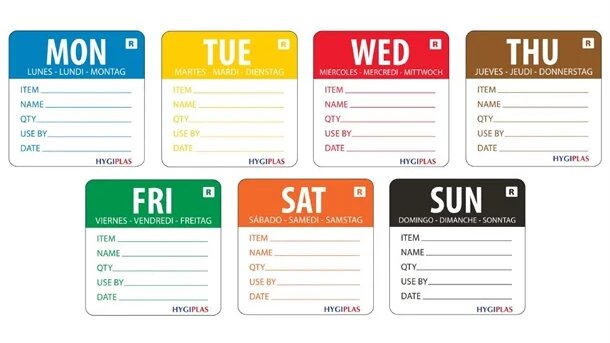
Labelling also encourages the FIFO (First In, First Out) method, a cornerstone of stock rotation. By using day-of-the-week labels or color-coded stickers, staff can easily identify older stock and prioritize its use. This reduces spoilage, minimises food waste, and saves money on food costs.
Food Labels from Catering Equipment Ltd are ideal for best practice in the commercial kitchen.
The set comes with colour coded labels for 7 days of week, each with spaces for the product name, persons' name, date, quantity and use by date.
While manual labeling may seem basic, it’s a powerful tool for maintaining a clean, organized, and compliant kitchen. It’s also highly adaptable—ideal for small restaurants, catering operations, and food trucks where digital systems may not be practical.