12 December 2025 | DEWESoft UK Ltd
Pantograph & Catenary Testing with Dewesoft & CETEST
In the dynamic world of railway testing, innovation thrives on collaboration.
For over a decade, CETEST and Dewesoft have exemplified the power of partnership, working hand in hand to advance the limits of railway testing—whether on tracks or in the lab. Their shared commitment to precision, adaptability, and excellence has transformed challenges into milestones, elevating railway testing standards across the industry. Multi-attribute rail testing and monitoring is evolving beyond simple measurement. The goal is to gain deeper insights and accelerate innovation, whether to develop new products or achieve operational excellence.
Introduction
CETEST is a test and analysis center based in Spain. It is accredited to ISO/IEC 17025 and has over 30 years of experience in railway technology. It has worked with and helped top global railcar manufacturers, including Alstom, CAF, Hitachi, Stadler, and Siemens. CETEST has industry-leading expertise in the interaction between pantographs and overhead lines. In addition to being critical for delivering power to the vehicle, the interaction between the pantograph and the OHL also affects maintenance costs.
Carlos Carmuega Tena, Head of Test and Measurement at CETEST, plays a central role in these efforts. He and his team have developed a high-precision instrumentation system for contact force and acceleration measurements. This solution has been tested across hundreds of variables on numerous railway systems.
"Dewesoft is one of our top suppliers, providing us with software and hardware that help us carry out tests in very short timeframes and offer great flexibility in instrumentation, thanks to the modularity of their products, which allows us to expand or reduce the number of channels easily.Thanks to Dewesoft, we can perform complex setups and instrumentation in reduced times, synchronizing multiple channels and placing the equipment in hostile environments, such as high-voltage areas, while still obtaining all data in a synchronized manner — as in the case of pantograph testing, where we isolate data through optical fiber.The software allows us to view data in real time and perform quick analyses while testing the vehicle."
Carlos CARMUEGA TENA, Quality Director CETEST, Spain
Dewesoft is a technology company that designs and manufactures advanced DAQ (data acquisition) systems for various R&D and monitoring applications in railway, civil engineering, energy and power, automotive and commercial vehicle, and aerospace industries. Dewesoft supports CETEST to solve numerous electrical railway testing and monitoring applications. This partnership enables rail operators and vehicle manufacturers to seamlessly transition from controlled laboratory environments to real-world track testing, delivering unmatched safety, reliability, and efficiency, and helping them win more business with proven performance.
The Challenge
The challenges in measuring the interaction between the pantograph and catenary line in railway vehicles are multifaceted. The pantograph is a component that connects a train to the overhead line (OHL) catenary system, drawing power from 15,000 V or even 25,000 V to power the electric vehicle's motor. Regardless of the train’s speed, it must maintain a safe, stable, reliable electrical connection. The high-speed railway environment is the most dynamic, characterized by high electromagnetic interference (EMI and RFI), dynamic mechanical factors, and wear and tear. Trains operate in all possible weather conditions, including wind, rain, snow, ice, humidity, and extreme temperatures. Overcoming these challenges requires advanced sensor and measurement technology, precise data interpretation, and rugged systems and sensors designed to handle the complexities of the real-world railway environment.
With Dewesoft DAQ instruments and several specialized sensors, CETEST has developed a pantograph overhead line testing and monitoring solution. This article explains the key railway subsystems involved and how they are tested.
What is a Pantograph?
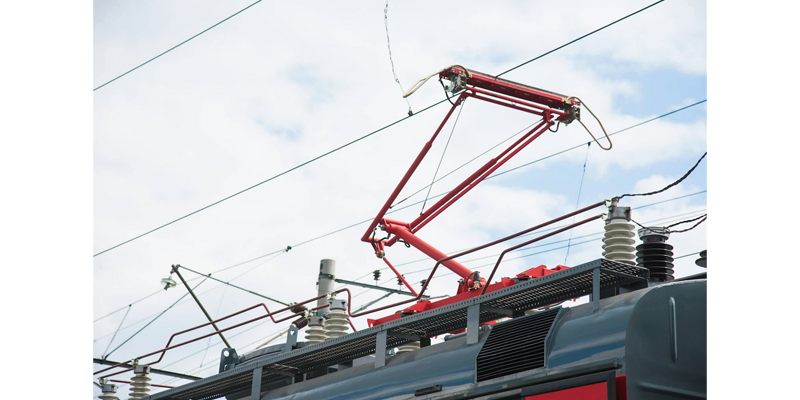
Trains often use overhead systems to connect to electric power. These systems include a pantograph, an articulated, spring-loaded mechanism mounted on the train's roof that collects electrical power from overhead lines (OHL). The smooth and consistent interaction between the pantograph and OHL is critical with conventional trains. Still, it becomes even more pronounced with high-speed trains traveling at 350 km/h (~217 mph).
Typically constructed from lightweight but robust materials such as carbon fiber-reinforced polymers and aluminum alloys. They usually include a lower arm, an upper arm, and a contact strip, often made of carbon or a carbon-copper composite, to minimize arcing and wear. Real-time adjustments in contact force are controlled via pneumatic or electronically actuated systems to compensate for aerodynamic lift, wind pressure, and variations in wire height. Precision in pantograph design and control is critical to minimize contact loss and prevent damage to the pantograph and the catenary system.
What is the Catenary System?
This article focuses on testing pantographs, but it’s essential to understand what the catenary system is and how it interacts.
An overhead catenary system (OCS) consists of tensioned wires that are somewhat flexible and a main overhead line (OHL) that supplies electricity to electric locomotives, trams, or light rail vehicles. It consists of one or more uninsulated conductors (or contact wires) suspended over the railway tracks and supported by structures such as poles, masts, or bridges. The contact wire is typically made of a hard-drawn copper alloy, which provides high conductivity and wear resistance. A system of weights or springs holds it at a constant tension to ensure good contact with the electric vehicle's pantograph.
In some catenary systems, a second wire, called a messenger or catenary wire, is suspended above and parallel to the contact wire. The contact wire is then suspended from the messenger wire by a series of vertical wires, known as droppers or hangers. This design allows for greater spacing between the support structures. It provides better current collection at higher speeds by reducing the sag of the contact wire and improving its vertical elasticity.
Catenary systems are essential for electric railways, providing a reliable and efficient means of power transmission to the trains. The design and maintenance of catenary systems are critical to ensure safe and uninterrupted railway operations. Factors such as voltage, current capacity, train speed, and environmental conditions are considered in the design of these systems.
Conclusion
The partnership between CETEST and Dewesoft offers a scalable measurement solution for rail engineers, enabling comprehensive multi-physics signal acquisition. This capability provides precise insights into railway infrastructure, individual system elements (like bogies and traction motors), critical components (such as pantographs and wheels), and the overall vehicle behavior. By scaling this integrated solution, rail engineers can make data-driven decisions to improve safety, operational efficiency, and extend the lifespan of railway assets, ultimately contributing to a more reliable and efficient railway network.
Please contact CETEST or Dewesoft to move your next railway project forward.