08 January 2026 | DEWESoft UK Ltd
Vibration Monitoring Eliminates The Need for a Tuned Mass Damper in Vienna’s DC Tower 2 Building
During the construction of Vienna’s DC Tower 2, engineers faced a crucial question: would the skyscraper require a costly Tuned Mass Damper to limit wind-induced vibrations?
Using real-time vibration monitoring and a digital twin model in combination with Dewesoft MEMS sensors, REVOTEC zt gmbh gathered live structural data in cooperation with PORR Bau GmbH to predict the tower’s stiffness and natural frequencies. The result — precise insights that ultimately eliminated the need for the damper, saving several floors and millions of euros.
Introduction
Civil engineers apply tuned mass dampers in tall buildings, bridges, and other structures. These devices reduce structural vibrations by using a large mass mounted on a spring-damper system.
The damper is ‘tuned’ to the structure's resonant frequency, causing it to oscillate out of phase with the structure's motion. This action absorbs and dissipates the structure's vibrational energy, thereby reducing sway from events such as wind or earthquakes. However, such a system is costly.
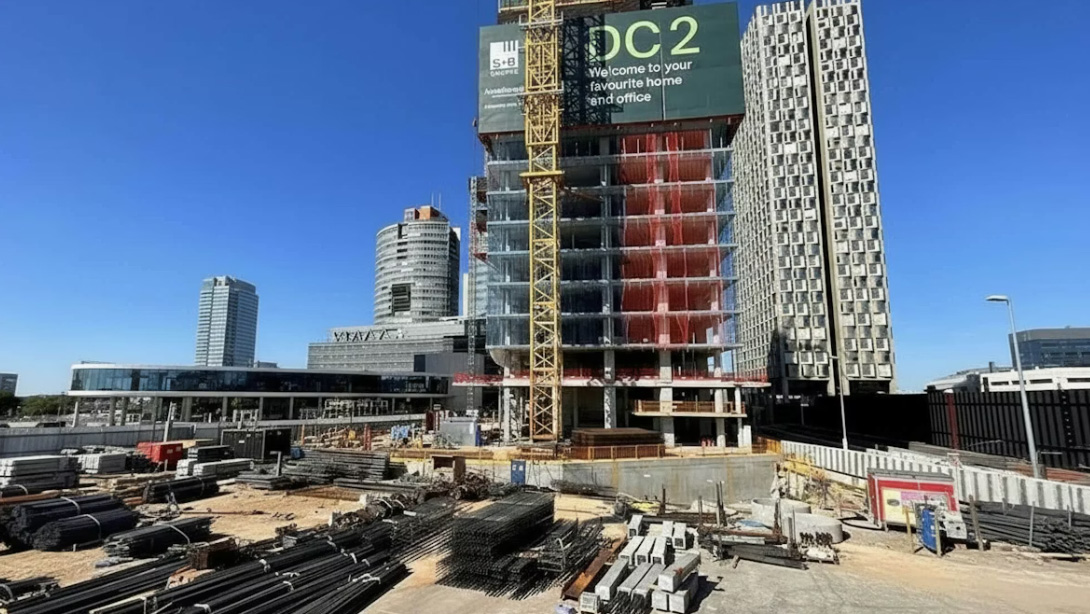
In Vienna, the capital of Austria, in the area known as Donau City, the French architect Dominique Perrault has designed a cluster of skyscrapers, the three Donau City (DC) Towers. As the tallest skyscraper in Austria, DC Tower 1, standing at 220m high (250m including the antenna), was completed in 2013. DC Tower 3, measuring 110m, was finished in 2022, while DC Tower 2 is now in the finishing phase.
The project partners
While the Vienna DC Tower 2 was under construction, the Austrian building company PORR Bau GmbH sought to determine as soon as possible whether a Tuned Mass Damper (TMD) was necessary to ensure the structure’s safety and comfort. The assessment is of significant interest because the implementation entails substantial costs and the loss of several floors that could otherwise serve as living spaces.
PORR Bau GmbH is active in Austria and Central Europe across government services, building construction, industrial construction, civil engineering, mineral resources, exceptional foundation engineering, tunnel construction, environmental technology, and transport infrastructure construction.
Together with the department “Technology Management and Innovation” of PORR Bau GmbH, the Civil Engineering companies REVOTEC zt gmbh and ghp gmeiner haferl&partner zt gmbh used real-time monitoring and a real-time built Digital Twin Model for vibration analysis of the DC Tower 2, leveraging Dewesoft equipment to inform data-driven decision-making.
The DC Tower 2 is approximately 175 meters high with 53 stories and six underground levels. The building is about 59m long and 26m wide, with a total gross floor area of approximately 62,800 m², including 314 flats, offices, restaurants, and shops. It also provides 216 parking places.
The work of the special foundation engineering team of PORR Bau GmbH involved excavations to a depth of 22.7 meters, using advanced techniques such as diaphragm walls and injection anchors. Reinforced concrete without joints characterizes the DC Tower 2 construction. It has a stiffening core and two transverse shear walls for the horizontal load transfer. The builders have scheduled the tower's completion for autumn 2026.
The issue
Due to their nature, high-rise buildings are more exposed to environmental conditions such as wind or earthquakes. Vibrations, therefore, need to be kept below certain vibration levels—first to ensure the integrity of the structure and second to provide comfort for the residents. For example, people working in an office are generally less sensitive to vibrations than residents in their homes sleeping at night.
To compensate for winds, the neighboring building, DC Tower 1, already has an in-built 350-ton pendulum on top, a so-called “Tuned Mass Damper” (TMD), for which Mr. Martin Haferl, structural engineer and structural designer at ghp gmeiner haferl&partner zt gmbh, was involved in the planning. When the building moves, the pendulum swings in the opposite direction. A damper slows the pendulum's kinetic energy, thereby reducing the tower oscillation.
The question was whether the DC Tower 2 would need a TMD? And how to know this as soon as possible, while the skyscraper is still under construction? The assessment is of significant interest because implementing a TMD involves high costs and the loss of several floors that could otherwise serve as living spaces.
The strategy and the challenges
Since this region of Vienna is known for strong winds, the dynamic wind-induced vibrations had already been investigated and reported. The comfort limit (i.e., maximum top horizontal acceleration) is 1.5% g for a wind of 10-year return. Wind tunnel testing and simulation of DC Tower 2 showed a slight exceedance of 1.59% g, requiring a passive TMD at the design stage. However, previous studies also showed a gap between the design estimation and the actual modal parameters characterizing the real tower.
The urgent need to decide on installing a passive TMD has prompted PORR Bau GmbH and REVOTEC zt gmbh to develop a framework that couples real-time monitoring with a 3D digital twin model of the tower, providing the actual natural frequencies and damping ratios in real time throughout construction.
Vibration measurements began when the building was 1/4 of its height. The engineers progressively extended the measurement chain and constantly adjusted the 3D digital twin model as the building grew.
The permanent vibration monitoring system
The engineers installed the permanent vibration-monitoring system during the construction of DC Tower 2. The system comprised a control cabinet, a weather station, and acceleration sensors. It is well known that shear walls and core walls in high-rise buildings transfer more horizontal load than columns do. Therefore, the measurement layout for evaluating the modal parameters and wind-induced vibrations of DC Tower 2 accounted only for the perimeter of the stiffening core.
The tower's natural frequencies and corresponding vibration modes, estimated at the design stage, were used to determine the installation of three accelerometers per floor, spaced at every quarter-height of the tower. The setup should capture not only the translational vibration modes, i.e., bending modes, in the weak X- and strong Y-directions of the tower, but also its torsional mode and its coupled translational-torsional modes.
Although a single accelerometer measured the tower's natural frequencies, it was only possible to link them to the tower's natural vibration modes (i.e., mode shapes) by installing three accelerometers per floor.
The engineers mounted three accelerometers at every quarter-height of the tower, using real-time monitoring data to build a digital twin model that displays the mode shapes in 3D. While construction was in progress, they installed three accelerometers per floor at each quarter-height of the tower, i.e., the 16th at 49.6 m, the 28th at 88.0 m, the 41st at 129.6 m, and the 53rd at 166.3 m. In total, 3 * 4 = 12 accelerometers (S1-S12) were present in the final state.
On top of the K2 crane at the construction site, the engineers also installed a weather station. The station should monitor, in real time, the environmental effects, such as dynamic wind impact, on the DC Tower 2 modal parameters and forced vibrations. They chose the K2 crane based on its proximity to the Danube River. The weather station recorded the wind speed and direction in real time.
By combining wind data from the weather station with wind-induced vibration data from accelerometers on DC Tower 2, engineers could accurately assess forced vibrations and link vibration amplitudes to specific wind forces. An electrical cabinet controlled and managed the measurement system, ensuring the data collected were reliably captured, processed, and transmitted.