12 February 2026 | Macalloy Ltd
The Long-Term Impact of Sealant Use on Macalloy Threaded Steel Bar Systems
Project Background An examination of two similar Macalloy installations further emphasised that the application of sealant is an important and essential factor in ensuring the durability and corrosion resistance of the Macalloy architectural bar systems' threads.
During the mid-1990s, two architectural projects utilised the Macalloy architectural tension bar systems, and both projects were located in similar environments where the tension bars were installed in external applications.
Project A: This project employed the sealant method advised by Macalloy, which was subsequently applied to the bar threads and clevis forks following installation. The sealant was introduced into the system via the lock cover sealant-holes, and fork chambers respectively.
Project B: Did not to use the sealant method, relying solely on the inherent corrosion resistance of the steel.
27-Year Results Comparison
Project A – Employed the Sealant Method
- Condition At Time of Inspection: The threaded areas of the assemblies remain in excellent condition with minimal signs of corrosion. Maintenance costs have remained low, and only routine inspections and minor repairs required.
The structural integrity of the system is fully intact, with no performance degradation.Project B – Did Not Employ the Sealant Method
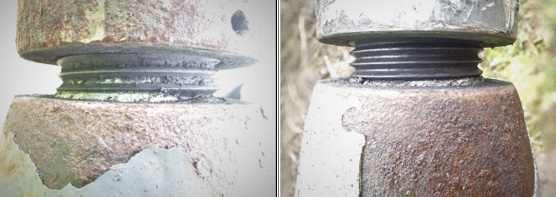
Condition At Time of Inspection: Severe corrosion observed within the threaded areas of multiple bar assemblies.
Considering that the bars had not undergone regular maintenance for approximately 27 years, and without any sealant applied post-installation, a later inspection resulted in the recommendation to replace the impacted tension bar systems.
Project A and Project B Overview
Category | Project A – Sealant Applied | Project B – No Sealant Applied |
Installation year | Mid-1990s | Mid-1990s |
Environment | External application | External application |
Protective sealant | Applied post-installation to threads and clevis forks | No sealant applied |
Corrosion protection method | Physical barrier protection of threaded zones | Reliance on inherent steel corrosion resistance |
Condition after ~ approx. 27 years (2022 inspection) | Excellent condition with minimal corrosion | Severe corrosion within threaded areas |
Threaded bar condition | Threads fully protected, no significant degradation | Advanced corrosion and material loss observed |
Clevis fork condition | Internals remain sealed and intact | Corrosion present within fork chambers |
Maintenance requirement | Low – routine inspections and minor repairs only | High – major intervention required |
Structural integrity | Fully intact, no performance degradation | Compromised in several locations |
Operational impact | No disruption to building use | Temporary closure required for repairs |
Remedial works | Not required | Full replacement of affected tension rod systems recommended |
Overall performance outcome | Long-term durability and reliability achieved | Possible system compromise and safety risk |
Conclusion
This case study demonstrates that the application of high-performance sealants is a critical design and installation requirement for durability, safety, and whole-life cost efficiency of the Macalloy tension bar systems in exposed environments.
Why Sealants Are So Effective on Threaded Steel Bar Systems
Barrier Protection
Sealants form a continuous, impermeable barrier around threaded areas, preventing moisture, oxygen, and corrosive agents from reaching the voids within the tension rod assembly. By interrupting the electrochemical corrosion process, the risk of rust and pitting is significantly reduced.
Chemical Resistance
High-performance sealants are engineered to resist salt spray, marine exposure, industrial pollutants, and long-term UV degradation.
Flexibility and Adhesion
Sealants used in structural applications maintain strong adhesion under thermal movement and vibration, while remaining flexible to prevent cracking or peeling that could expose the steel.
Macalloy Sealant Method
Macalloy advises that a protective sealant should be applied as a standard practice for all Macalloy tension bar installations. This proactive strategy guarantees:
- Protection against corrosion in threaded areas
- Lower maintenance costs
- Qualification for extended warranties
- Enhanced safety and performance over time