10 March 2026 | Interface Force Measurements Ltd
What is vehicle interface force testing?
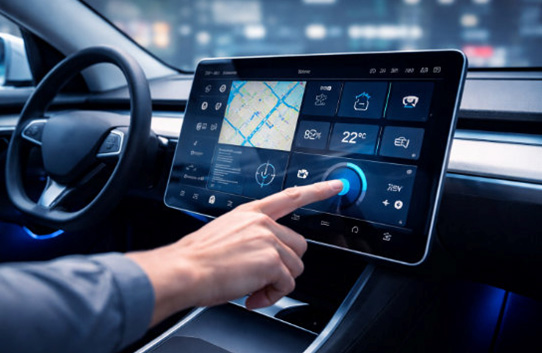
Automotive navigation interfaces have grown increasingly complex. Unlike traditional physical buttons, touch screens provide no tactile confirmation, which causes drivers to visually verify inputs on the vehicle’s touchscreen. Automakers need to test the haptic feedback to confirm user touch input through the vehicle’s onboard systems is working properly.
Interface solution: SMTM Micro S-Type Load Cells for touchscreen testing
Interface’s SMTM Micro S-Type Load Cells were installed behind the bezel mount points of the vehicle’s touchscreen interface, with Load Cell Load Buttons passing through each load cell to secure both the load cell and the screen assembly. When the user tapped the screen, the SMTM measured the contact force, and the analog output was captured through the compact, high-speed 9330 indicator. The measurements can be captured using the 9330 Battery Powered High Speed Data Logging Indicator through an SD card, or another laptop directly.
How our vehicle interface force testing solutions captured accurate touch input forces and validated automotive haptic feedback systems.
How SMTM Load Cells capture contact force
- The SMTM Micro S-Type Load Cells are mounted behind the bezel attachment points of the vehicle’s interface or display, with Load Cell Load Buttons passing through each sensor to secure the assembly.
- When the driver taps the display surface, the SMTM’s measure the applied contact force.
- Data logged through 9330 and displayed on laptop or PC.
Benefits of vehicle force testing in automotive systems
With our force measurement solution, the automotive system could accurately detect user touch input and provide haptic feedback confirmation.
Components & Materials Used in Force Measurement Setup
A clear inventory of components helps engineers source the right sensors and instrumentation for vehicle touchscreen force testing:
- SMTM Micro S-Type Load Cells
- Load Cell Load Buttons
- 9330 Battery Powered High Speed Data Logging Indicator (with BlueDAQ Software)
- Car interface undergoing test
Vehicle interface force testing – find out more
Products:Read about our SMTM Micro S-Type Load Cells.9330 Battery Powered High Speed Data Logging Indicator.Applications:Find out more about how we help with automotive testing applications.Case Study:Why electric vehicle battery temperature matters to Ford.Accelerating excellence at an automotive testing lab.Blog articles:The future of automotive performance requires precise torque measurement.Please get in touch to discuss how we can help with your next automotive project.
FAQs – Frequently Asked Questions
Q1. What is force measurement in vehicle interfaces?
A: Force measurement in vehicle interfaces refers to quantifying the mechanical force applied by users (like tapping a touchscreen). It ensures that onboard systems correctly detect input and provide responsive haptic feedback — particularly important where no physical buttons exist.
Q2. Why is touchscreen force testing critical in modern vehicles?
A: Modern automotive touchscreens replace tactile buttons, requiring precise force measurement to verify that user inputs are reliably detected and accurately trigger feedback responses. This is crucial for both safety and user experience.
Q3. What are SMTM Micro S-Type Load Cells?
A: SMTM Micro S-Type Load Cells are compact force sensors designed to measure applied contact force in confined spaces, such as behind a vehicle’s touchscreen bezel. They convert mechanical force into electrical signals that can be logged and analysed.
Q4. How does the 9330 High-Speed Data Logging Indicator help in testing?
A: The 9330 indicator captures high-speed force data from the load cells and logs it to an SD card or directly to a PC using BlueDAQ software. This enables engineers to analyse input force profiles and verify system performance.
Q5. What types of engineers use vehicle interface force testing?
A: Automotive test engineers, UX designers, systems integration specialists, and quality assurance teams use vehicle interface force testing to validate user interfaces, improve haptic feedback, and meet regulatory and safety standards.
Q6. How is haptic feedback confirmed using force measurement?
A: Force measurement helps confirm that when a user taps the interface, the system detects the correct magnitude and pattern of contact force, enabling the onboard software to generate the appropriate haptic response.
About Interface Force
Interface Force Measurements Ltd is a UK-based engineering company specialising in force, torque, and pressure measurement systems.
As the master distributor and technical centre for Interface load cells across the UK, Ireland, the Middle East, and North Africa, we don’t just supply components — we design, integrate, and calibrate complete measurement solutions.
With our UK calibration laboratory, we provide in-house testing, verification, and support for all our products and systems, giving customers manufacturer-level quality with local service and expertise.
We also represent other leading sensor brands — DDM Sensor Solutions, AMTI Force and Motion, GP:50, and XSENSOR Intelligent Dynamic Sensing — chosen for their shared commitment to quality, reliability, and performance.