19 March 2026 | Notice Board Company UK Ltd
The Biggest Myth About IP Ratings and Outdoor Notice Boards
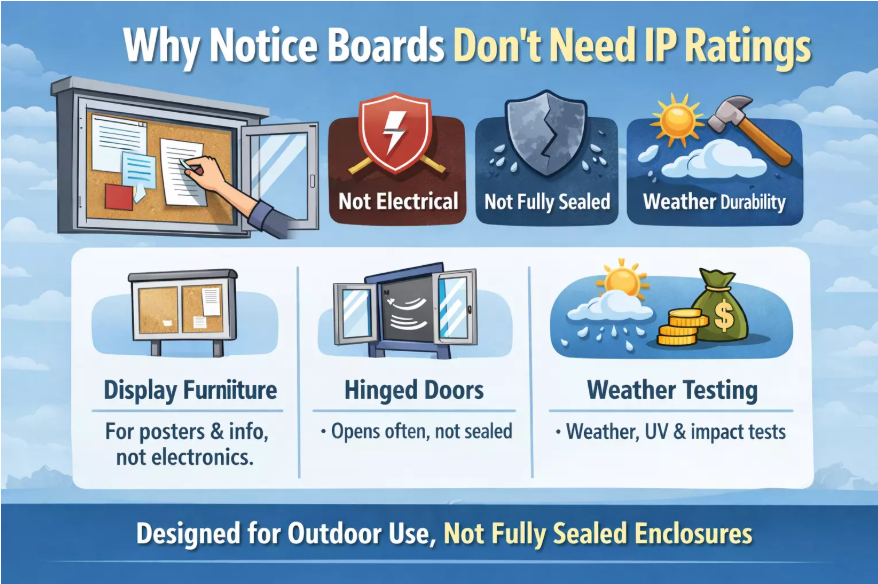
Outdoor notice boards typically do not have IP ratings because they are not sealed electrical enclosures and are designed to be opened regularly. Instead of ingress protection testing, their suitability for outdoor use is demonstrated through weather resistance, durable materials, and impact protection.
Why Outdoor Notice Boards Don’t Need an IP Rating
When specifying equipment for outdoor environments, it’s common to see IP ratings used to describe protection against dust and water. Because of this, many people assume that outdoor notice boards should also have an IP rating to prove they are weatherproof.
However, this is not normally the case. Most external notice boards are not designed or tested under IP standards, and in practice they do not need to be. This is because notice boards are classified and designed differently from sealed electrical enclosures.
Below we explain why outdoor notice boards typically do not carry an IP rating and what actually matters when choosing a notice board for outdoor use.
1. IP Ratings Are Intended for Electrical Equipment
IP (Ingress Protection) ratings are defined in the international standard IEC 60529. The system is designed to classify how well electrical enclosures protect internal components from dust and water.
Common products that carry IP ratings include:
junction boxes
lighting fittings (luminaires)
electrical control panels
outdoor electrical cabinets
Outdoor notice boards are different. They are generally considered display furniture or signage, rather than equipment designed to house electrical components. For this reason, manufacturers typically do not test notice boards under the IP classification system.
2. Notice Boards Are Not Fully Sealed Enclosures
IP testing assumes that an enclosure remains fully sealed during testing against dust and water ingress.
Outdoor notice boards are designed differently because they need to be accessed regularly to change posters or notices. Typical design features include:
hinged doors
ventilation gaps
drainage openings
regular access for updating information
Because the enclosure is designed to be opened frequently, it cannot reliably maintain the sealed conditions required to achieve a formal IP rating.
3. Weather Resistance Is More Relevant
Instead of ingress protection testing, outdoor notice boards are usually assessed based on their ability to withstand environmental conditions.
This can include considerations such as:
resistance to rain and moisture
UV resistance from sunlight exposure
corrosion resistance of frames and fixings
durability of glazing and seals
In some cases, products may also be assessed for mechanical strength under standards such as IEC 62262, which measures resistance to physical impacts.
These types of assessments are often more relevant to outdoor signage than strict ingress protection testing.
4. IP Certification Is Often Unnecessary
Achieving an official IP rating requires specialised laboratory testing, which can add significant cost to a product.
For items like notice boards, manufacturers generally focus on designing products that are durable and suitable for outdoor conditions, rather than pursuing formal ingress protection certification.
As a result, outdoor notice boards are often described using practical terms such as:
weatherproof
water-resistant
suitable for outdoor use
These descriptions usually provide sufficient information about how the product will perform outdoors.
The Biggest Myth About IP Ratings and Outdoor Notice Boards
One of the most common misconceptions is that any product used outdoors must have an IP rating to prove it is weatherproof.
In reality, IP ratings were created specifically for sealed electrical enclosures under the standard IEC 60529. These ratings measure how well an enclosure prevents dust or water from entering and affecting electrical components.
Outdoor notice boards are designed differently. They are display cases that are regularly opened to change information, and they often include small ventilation gaps or drainage points to prevent moisture build-up. Because of this, they cannot function as permanently sealed enclosures in the same way electrical equipment can.
In fact, making a notice board completely sealed could actually create condensation problems, as trapped moisture would have no way to escape.
What really matters for outdoor notice boards is good design and durable materials, such as:
corrosion-resistant frames
UV-resistant glazing
weather-resistant seals
proper ventilation and drainage
These features ensure the notice board can withstand real outdoor conditions while still allowing easy access to update information.
Put simply, the absence of an IP rating does not mean a notice board is unsuitable for outdoor use. It simply reflects that the IP classification system was never intended for this type of product.