07 May 2026 | EJOT UK Ltd
EJOT CROSSFIX®: Driving Efficiency and Thermal Excellence in Leeds’ Climate Innovation District
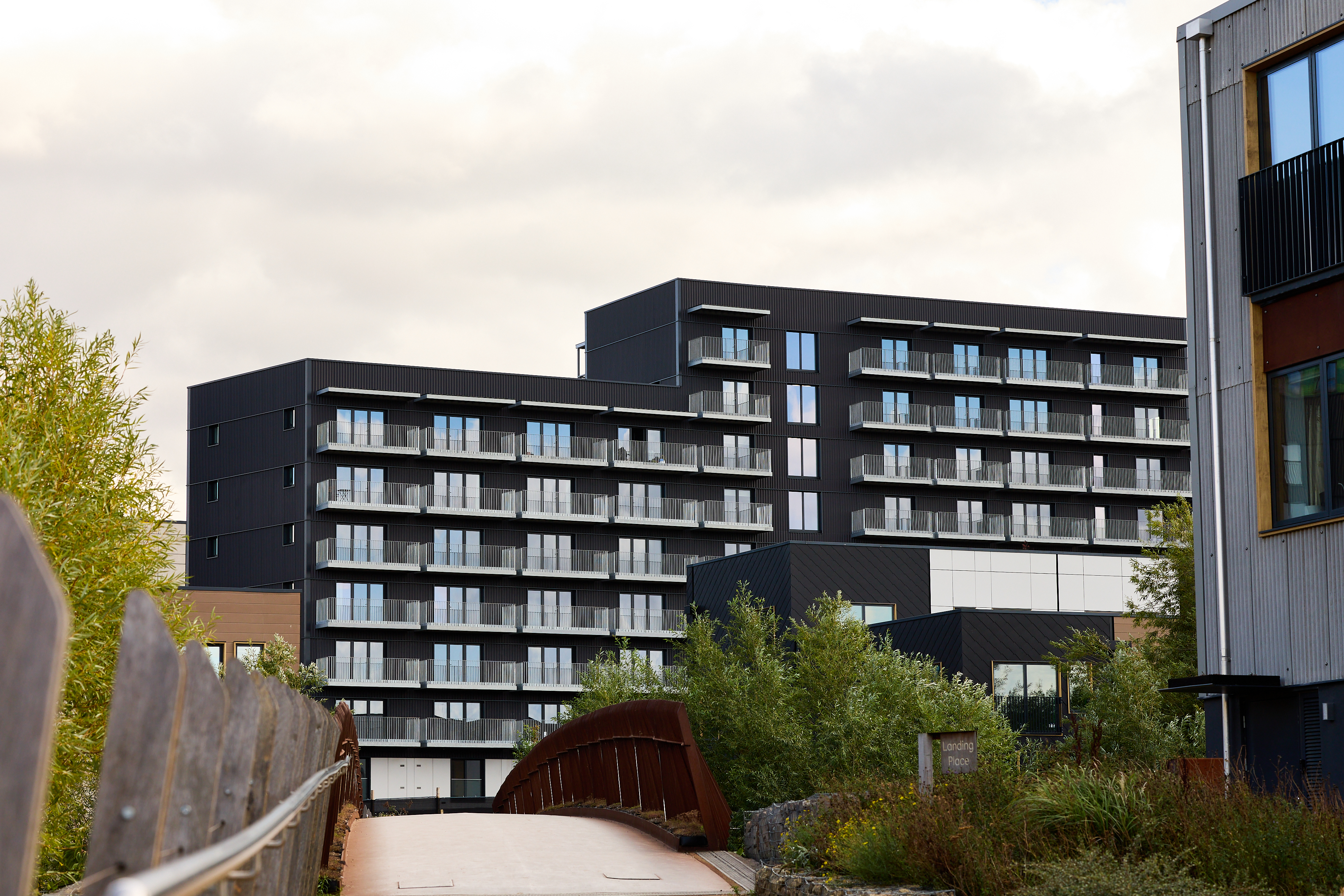
The construction of two apartment buildings within the climate innovation district, an urban regeneration project in Leeds proves how EJOT’S substructure system can be used to integrate rainscreen facades into highly sustainable buildings, without significantly increasing insulation depth.
The project is the result of a collaborative effort between Citu, Scandinavia’s White Arkitekter a leader in architectural practices, and civil and structural engineers Civic. Together, the scheme is creating a new sustainable neighbourhood with excellent quality urban housing. More than 500 low-energy homes with incorporated amenities have been made to a design that has been PHPP (Passive house planning Package) assessed. The two buildings in question, known as Aire Lofts and District Lofts, provide a vital mix of private and affordable housing, including sixteen units dedicated to social rent and sub-market intermediate housing.
Both volumes, named Aire Lofts and District Lofts, are constructed using a steel structure with composite metal deck floors and a light-gauge steel framing system. This facilitates a rear ventilated façade (RVF) featuring two types of Swisspearl fibre cement panels externally, providing a consistent aesthetic across both multi-storey buildings, which rise up to 10 floors in height.
EJOT CROSSFIX® was selected to provide the critically important substructure because it enabled the construction of a highly insulated façade without compromising aesthetics, with the added benefit of streamlining installation.
Working alongside main contractor Artium Construction, Hansen Facades completed the entire exterior of District Lofts using the CROSSFIX system. The system was selected based on its proven performance at Aire Lofts, where the system’s versatility and effectiveness were first recognised by Citu after it was used for secret-fix panels used to demarcate duplex apartments at the ground and first floor levels.
The EWS1 (External Wall System 1) rating for both volumes required that all facade materials, including specified attachments, be classified as A1 ‘non-combustible’ to minimise the fire risk. Optimising the fire performance included the incorporation of FSi open and closed state cavity barriers, along with RCM Y-Wall A1 non-combustible sheathing boards.
These fire safety objectives were balanced with thermal and ventilation goals. Given the high thermal requirements, the substructure cavity had to be sufficiently deep to accommodate Rockwool Duo-Slab insulation with a thickness of 250mm and maintain the required ventilation for a system of this type.
The deep layer of insulation was one of the most important façade components needed for both buildings from a thermal perspective. The facades had to meet a weighted U Value (based on a typical subframe arrangement) of 0.13 W/m²k, which was key to delivering on the developer’s commitment to providing homes with heating energy demand around five times lower than the average UK house. However, CROSSFIX was also instrumental in making this high level of thermal performance a reality.
The CROSSFIX substructure comprised 220mm Konsole K1 brackets in A2 stainless steel, featuring the Powerkey in the same grade for improved structural stability while supporting L, Z, and T profiles. This was accompanied by EJOT’s package of five stainless steel fastener types to ensure secure assembly and consistent performance.
Due to its very low thermal conductivity, the stainless-steel composition of CROSSFIX was vital in meeting the facade’s thermal goals by minimising thermal bridging. This, combined with a thermal stop in the Konsole, resulted in a lower U-value than would have been achievable with alternative substructures using the same insulation thickness.
Furthermore, from a life-cycle perspective, CROSSFIX is primarily made of recyclable stainless steel. As confirmed by an Environmental Product Declaration (EPD), this material requires significantly less energy to manufacture than the components of other RVF substructure systems.
The multiple sustainability benefits of CROSSFIX, further enhanced by its ‘non-flammable’ fire resistance rating and unique design flexibility for both horizontal and vertical assembly, ensure it aligns with the higher efficiency, safety, and quality standards of modern construction.
At the Climate Innovation District, CROSSFIX delivered significant efficiency gains because the system does not require specialised or handed brackets in constrained areas, such as between windows and other openings. The substructure’s versatility further allowed a single subframe system to be used for both secret-fix and face-fixed cladding.