19 October 2026 | JAS Welding Services Ltd
Swing vs Sliding Driveway Gates: Which Is Right for Your Property?
Swing or sliding? Compare driveway gate types on space, slopes, security, automation and maintenance, and find out which bespoke steel gate suits your home or business.
A good set of steel gates makes a property look smarter, feel more private and stay more secure. But before you think about colours and designs, there's one big decision to make: swing or sliding?
Both work well in the right place. The best choice depends on your driveway, your space and how you'll use the gates every day. Here's how to decide.
How Swing Gates Work
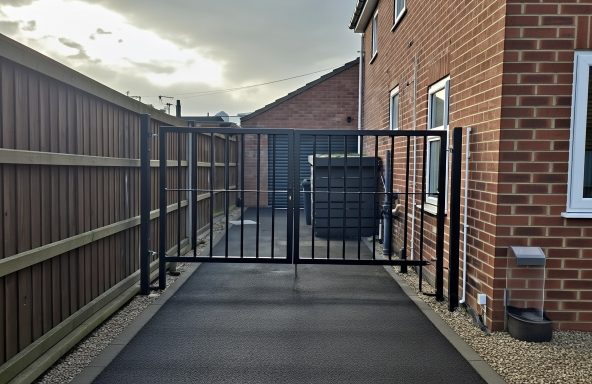
Swing gates are hinged on one side and open like a door. They can be a single leaf or a pair that meets in the middle, and they can open into the property or, in some cases, outwards.
Advantages of Swing Gates
- Classic look that suits period homes, farmhouses and traditional properties
- Simple installation on posts or existing brick piers in many cases
- Fewer moving parts than a sliding system
- Work well on wide, level driveways with plenty of room behind the gate
Things to Watch
- You need a clear swing area for the gates to open into, free of parked cars, bins and planting
- Sloping driveways can be a problem if the ground rises behind the gates, although rising hinges or opening outwards can sometimes help
- In windy spots, large solid leaves can catch the wind, so the design and automation need to allow for it
How Sliding Gates Work
Sliding gates run sideways along the boundary, parallel to the fence or wall. They either run on a track set into the ground or are cantilevered, carried on rollers so nothing touches the driveway.
Advantages of Sliding Gates
- No swing space needed, so they're great for short driveways and properties that park close to the gate
- Handle slopes better, because the gate moves across the opening rather than into the driveway
- Ideal for wide openings and commercial entrances
- Very secure, as they're hard to force open and can't be lifted off hinges
Things to Watch
- You need clear run-back space along the boundary, usually a little more than the width of the opening
- Tracked gates need the track kept clear of stones, leaves and ice
- Groundworks and foundations are usually more involved than for swing gates
Side-by-Side Comparison
- Space needed. Swing gates: swing area inside or outside the opening. Sliding gates: run-back space along the boundary.
- Sloping drives. Swing gates: can be tricky. Sliding gates: usually better.
- Short driveways. Swing gates: can be awkward. Sliding gates: ideal.
- Wide openings. Swing gates: possible, but large leaves get heavy. Sliding gates: ideal.
- Look. Swing gates: traditional, classic. Sliding gates: modern, clean.
- Automation. Swing gates: ram or underground motors. Sliding gates: single motor on a rack.
Automation: Making Life Easier
Most of the gates we make are automation-ready, so motors can be fitted at installation or added later. Automation gives you remote, keypad or phone entry, and it's especially useful on busy commercial sites.
Powered gates must be designed and installed with safety in mind. This means the right safety devices, such as photocells and safety edges, correct force settings and regular servicing. Planning for automation at the design stage means the gate frame, hinges or rollers and foundations are built for it from day one.
Design, Materials and Finishes
Because we fabricate our gates in our own Norwich workshop, they can be made to measure in almost any style:
- Virtical bar, flat-top or arched designs
- Solid infill or slatted panels for privacy
- Laser-cut decorative panels, house names or logos
- Matching pedestrian gates, railings and fencing
For a long life outdoors, we recommend hot-dip galvanising followed by powder coating. This gives strong protection against rust and a tough, smart colour finish.
Which Should You Choose?
As a quick rule of thumb:
- Choose swing gates if you have a level drive, plenty of space behind the gates and want a traditional look.
- Choose sliding gates if your driveway is short or sloped, the opening is wide, or you want maximum security.
If you're still unsure, we're happy to visit, measure up and recommend what will work best for you.
Frequently Asked Questions
Do I need planning permission for driveway gates?
In many cases gates under a certain height don't need planning permission, but the rules depend on the height, location and whether the property is listed or in a conservation area. Check with your local planning authority if you're unsure.
Can my gates be automated later?
Yes. Our gates are built automation-ready, so motors can be added at a later date.
Which is more secure, swing or sliding?
Both can be very secure when built well. Sliding gates are often seen as slightly more secure, as they can't be pushed inwards or lifted off hinges.
How long do steel gates last?
With galvanising, a quality powder coat and a little care, steel gates can last for many years.
Do you make pedestrian gates to match?
Yes. We can make matching pedestrian gates, railings and fencing.
Get a Free Gate Quote
Ready for new driveway gates? Send us the width of your opening, a few photos of your driveway and any designs you like, and we'll get back to you with a free, no-obligation quote.