17 September 2026 | The Work Uniform Company
What Is Business Casual?
A Practical Dress Code Guide for Men, Women and Workplace Teams
Business casual is a workplace dress code that combines professional clothing with a more relaxed approach than traditional business formal attire. For men, this may include shirts, chinos, tailored trousers, knitwear and smart shoes. For women, it can include blouses, tailored trousers, skirts, dresses, knitwear and blazers.
The exact meaning varies between workplaces and industries. Some offices consider chinos and a polo shirt appropriate, while others still expect tailored trousers, a collared shirt and perhaps a blazer. For a broader overview of workplace dress codes, see our guide to what to wear for the office.
What does business casual mean?
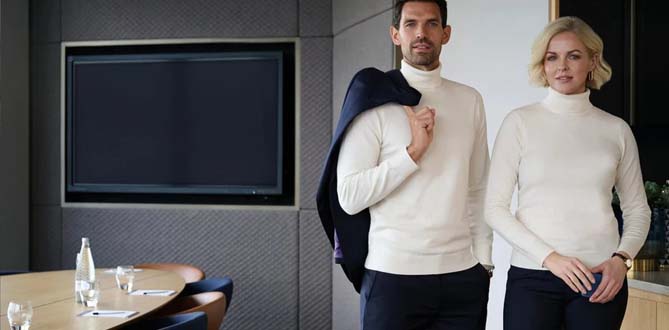
Business casual removes the need for a full matching suit while retaining a smart, workplace-appropriate appearance. Instead of wearing a suit, shirt, tie and formal shoes, an employee might combine chinos or tailored trousers with a shirt, blouse, fine-gauge jumper, cardigan or blazer.
Typical business casual clothing includes collared shirts, smart blouses, chinos, tailored trousers, office skirts, smart dresses, fine-gauge knitwear, blazers and smart footwear. The key is that these pieces can be mixed and matched rather than forming part of a matching suit.
Business casual vs business formal and smart casual
Business casual is generally more office-focused than smart casual. Smart casual may allow dark jeans, casual shirts and smart trainers, whereas business casual usually leans towards chinos or tailored trousers, collared shirts or blouses, fine-gauge knitwear and smarter footwear.
Business casual for men
Men's business casual usually centres on smart separates rather than a full suit. A reliable combination is a collared shirt or polo with chinos or tailored trousers and smart footwear.
Shirts, trousers and chinos
Oxford shirts, button-down shirts and other smart collared styles work well, particularly in white, pale blue, navy and subtle patterns. Browse Men's Work Shirts.
Chinos are one of the most common choices because they sit between formal suit trousers and casual jeans. Navy, black, stone and charcoal are easy to coordinate. Explore Men's Chinos or Men's Suit Trousers.
Knitwear and blazers
Fine-gauge jumpers, V-necks and cardigans can be layered over shirts without making the outfit feel too casual. Browse Men's Knitwear.
A blazer is not always required, but it is useful for meetings, presentations and customer-facing roles. A navy or charcoal blazer with chinos and an open-collar shirt is an easy way to raise the level of formality. Browse Men's Blazers.
Business casual for women
Women's business casual offers a wide range of options including blouses, shirts, tailored trousers, chinos, skirts, dresses, knitwear and jackets. The emphasis should remain on clothing that is comfortable, coordinated and suitable for the workplace.
Blouses, shirts and trousers
Blouses and smart shirts form the foundation of many outfits. Neutral colours such as white, ivory, pale blue and navy are particularly versatile. Browse Women's Blouses and Women's Work Shirts.
Tailored trousers can be dressed up or down depending on the rest of the outfit. Slim-leg, straight-leg and tailored fits can all work with blouses, knitwear or jackets. Explore Women's Work Trousers and Women's Suit Trousers.
Chinos can also work well in relaxed offices, reception teams and hospitality environments. Browse Women's Chinos.
Skirts, dresses, knitwear and jackets
Knee-length and midi skirts are versatile options that can be paired with blouses, shirts, knitwear and jackets. Browse Women's Office Skirts.
A tailored or shift dress provides a complete outfit with minimal styling and can be paired with a cardigan or jacket when a smarter appearance is needed. Browse Women's Work Dresses.
Fine-gauge cardigans and jumpers add a practical layer, while a blazer is an easy way to make an outfit more formal for meetings or customer-facing roles. Explore Women's Knitwear and Women's Suit Jackets.
Jeans, trainers and polo shirts: are they business casual?
Jeans may be acceptable in some workplaces, but this depends on the employer. Where permitted, dark, clean and well-fitting jeans without rips, distressing or prominent branding are the safer choice. Pairing them with a smart shirt, blouse, jumper or blazer helps maintain a professional appearance.
Some modern offices also allow clean, understated trainers. Neutral leather or leather-look styles are generally more suitable than running shoes or brightly coloured sports trainers. More traditional corporate, legal, financial and customer-facing workplaces may still expect loafers, brogues, court shoes or other formal footwear.
Polo shirts can be business casual in more relaxed workplaces, particularly in warmer weather. Choose a clean, well-fitting polo in a neutral or company colour and pair it with chinos or tailored trousers.
What colours work best?
Neutral colours are useful because they can be mixed and matched across a working wardrobe. Navy, black, charcoal, grey, white, light blue, stone and beige are all versatile choices. Businesses can then introduce company colours through shirts, blouses, ties, scarves, knitwear and embroidered logos.
What should you avoid wearing?
Although business casual is more relaxed than traditional corporate clothing, it is still a professional dress code. Depending on the workplace, the following are generally less suitable:
- Ripped or heavily distressed jeans
- Sportswear and gym clothing
- Flip-flops
- Heavily branded clothing or graphic T-shirts
- Very casual hoodies
- Dirty or worn footwear
- Clothing that is excessively loose, tight or revealing
Business casual across different industries
The appropriate level of formality often depends on the environment. Corporate offices may favour tailored trousers, shirts, blouses, knitwear and blazers, particularly for client-facing employees. Reception and front-of-house teams often benefit from a slightly smarter interpretation because they are the first point of contact for visitors.
Hotels and hospitality businesses can use business casual effectively for reception, management and front-of-house teams where appearance and comfort are equally important. Explore our Hotel Uniforms.
Sales and showroom teams may combine chinos, shirts, polos, knitwear and jackets to balance movement with presentation. Creative, technology and marketing workplaces may interpret the dress code more loosely, sometimes allowing dark jeans, polos and smart trainers.
Business casual outfit ideas
For men
- Navy chinos, pale blue Oxford shirt and brown loafers
- Charcoal trousers, white shirt and navy V-neck jumper
- Stone chinos, navy polo shirt and smart trainers
- Black tailored trousers, blue shirt and navy blazer
For women
- Black tailored trousers, white blouse and loafers
- Navy chinos, pale blue shirt and cardigan
- Midi skirt, blouse and lightweight knitwear
- Tailored office dress with a coordinating jacket
- Straight-leg trousers, undersuit top and blazer
How to build a business casual wardrobe
A versatile workplace wardrobe does not need a large number of garments. The aim is to choose pieces that coordinate easily and can be combined in different ways throughout the week. A practical starting point might include:
- 2–3 work shirts or blouses
- 2 pairs of tailored trousers or chinos
- 1 skirt or dress where appropriate
- 1–2 pieces of knitwear
- 1 blazer or suit jacket
- 1–2 pairs of smart shoes
Choosing complementary colours makes it easier to create several outfits from a relatively small number of garments.
Business casual uniforms for teams
Business casual is also useful for company uniforms because it creates a professional appearance without requiring every employee to wear a traditional suit. A coordinated staff wardrobe might combine branded shirts or blouses, chinos or tailored trousers, fine-gauge knitwear, blazers, polos for more relaxed roles and company-coloured ties or scarves.
Different departments do not have to wear identical garments. Consistent colours and logo personalisation can connect different outfits across the organisation. Explore our Menswear and Womenswear ranges.
Frequently asked questions
Do you have to wear a suit for business casual? No. A full matching suit is generally not required. Tailored separates such as trousers, chinos, shirts, blouses and jackets are more common.
Are chinos business casual? Yes. Chinos are one of the most popular options for men and women because they are smarter than jeans without being as formal as suit trousers.
What is the difference between business casual and smart casual? Business casual is generally more professional and office-focused. Smart casual allows greater flexibility and may include dark jeans, casual shirts and smart trainers.
What should I wear if I am unsure about the dress code? Choose a slightly smarter outfit such as tailored trousers or chinos, a collared shirt or blouse and smart footwear. You can then adjust once you understand how colleagues normally dress.