13 August 2026 | Meritas Fire & Security Protection Ltd
The Art of Compartmentation - Essential Strategies for Fire Safety in Buildings
Building Fire Safety: Why Compartmentation Matters
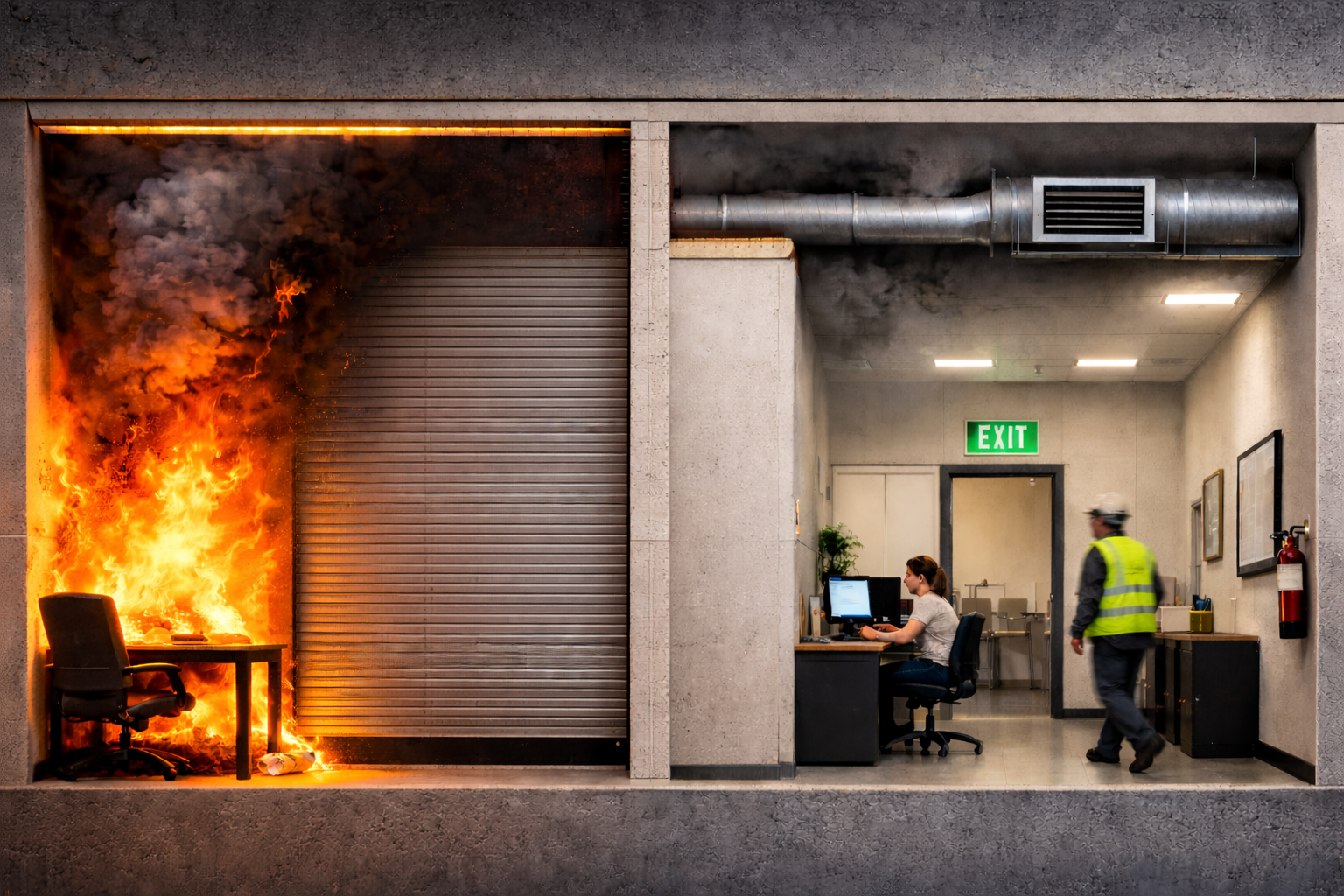
Visible fire-safety features such as alarms, extinguishers, emergency lighting and evacuation signs are important, but much of a building’s protection is built into elements people rarely notice. Fire compartmentation is a core part of Passive Fire Protection (PFP). Its purpose is to contain fire and smoke, safeguard escape routes and reduce damage from the outset of an incident.
For Meritas Passive Fire Protection, compartmentation is not simply a box-ticking exercise. It is an engineered, building-wide system intended to give owners, occupants and duty holders confidence that protection will be there when it matters. Effective compartmentation operates continuously and unobtrusively, without needing to be activated.
What fire compartmentation does
Compartmentation divides a building into separate fire-resisting areas, or compartments. Fire-resistant walls, floors and ceilings create these boundaries, while protected openings preserve their performance. Depending on a building’s use, scale and risk profile, a compartment may be required to resist fire and smoke for between 30 and 120 minutes.
Keeping a fire within its compartment limits its spread. This can help maintain structural stability for longer, keep adjoining areas more tenable, allow people time to evacuate and give emergency services a better opportunity to intervene. It also restricts the overall damage a fire may cause.
The UK framework
The Building Regulations 2010 provide the principal UK requirements for fire compartmentation. Approved Document B (Fire Safety) gives detailed guidance on matters including compartment dimensions, fire-resisting construction and protection for openings that cross compartment boundaries. The applicable requirements differ according to a building’s height, purpose and type.
Other relevant guidance includes BS 9999, which considers fire-safety design more broadly, alongside fire-resistance test standards such as BS 476 and the BS EN 1366 series. These documents establish minimum performance expectations, although meeting those expectations on paper does not by itself ensure that a system will perform effectively in a completed building.
Meritas applies the regulatory framework with technical judgement so that the intended fire strategy is delivered in practice. This is particularly significant in complex buildings, buildings with extensive services, and buildings that change during their lifetime.
Maintaining the fire-resisting line
Walls and floors that form compartment boundaries need both integrity and insulation. In other words, for their specified rating period, they must resist the passage of flames, hot gases and excessive heat.
The vulnerable areas are often the points where elements meet. Inadequate detailing, unsuitable fixings and unapproved product substitutions can all undermine a fire-resisting construction. Maintaining continuity is therefore essential: the installation on site must faithfully achieve the fire-resistance performance envisaged in the design.
Penetrations, services and fire stopping
Electrical cables, data services, pipework and ventilation systems routinely pass through walls and floors. Every such penetration can compromise a compartment boundary unless it is correctly sealed.
Fire stopping restores the required fire resistance where services have breached a fire-resisting element. It requires tested solutions, exact installation and close attention to the relationship between the service, the fire-stopping product and the supporting construction. Systems must be selected for the specific application and installed in accordance with the tested arrangement.
Meritas applies specialist knowledge to challenging service penetrations so that compartment lines remain protected and the selected fire-stopping systems can perform under fire conditions.
Fire doors: a critical part of the system
Fire doors allow buildings to operate normally while providing protection when a fire occurs. They are also a frequent source of compartmentation failure. A correctly rated door will still be ineffective if, for example, clearances are too large, seals are absent, or the hardware is unsuitable.
A fire door must be treated as a complete doorset. Its leaf, frame, seals, glazing, ironmongery and installation all contribute to its performance. Meritas takes this system-based view, ensuring fire doors operate as dependable components of the overall compartmentation strategy.
Addressing concealed routes of spread
Fire and smoke can travel through spaces that are not immediately visible, including ceiling voids, raised floors and wall cavities. If cavity barriers and fire-stopping measures are missing or incorrectly installed, these concealed routes may enable fire to bypass compartment boundaries and spread unnoticed until it has become established.
For this reason, effective compartmentation must cover both visible construction and hidden voids. Meritas places particular importance on identifying and protecting these less obvious paths.
Accountability and the Golden Thread
The Building Safety Act 2022 has increased the responsibility on duty holders to show that fire-safety measures have been designed, installed and maintained appropriately. A key concept is the “Golden Thread” of information: records that are clear, accurate and accessible throughout the life of a building.
Meritas supports this through comprehensive documentation, transparent reporting and clear evidence of compliance. These records assist with regulatory responsibilities while also helping building owners and managers understand the long-term condition and performance of their fire-safety measures.
More than compliance
Rules establish the required outcome, but successful delivery depends on expertise. Compartmentation failures commonly stem from misunderstanding, poor coordination or substandard workmanship rather than from an absence of regulation.
Meritas combines practical experience with technical knowledge to identify risks early, apply tested systems correctly and make sure fire strategies are understood across the project. The aim is not only to satisfy an inspection, but to provide compartmentation that can be relied upon in real fire conditions.
Continuous, passive protection
Unlike active systems, passive fire protection does not depend on power, manual operation or activation. Once correctly designed and installed, it provides continuous protection for the building’s lifetime.
By applying specialist Passive Fire Protection expertise and maintaining high standards, Meritas helps owners, employees and residents feel confident about building safety. When compartmentation is approached as both a technical discipline and a craft, it remains one of the strongest means of protecting people, property and peace of mind.
Visit https://meritas.co.uk to find out more.