13 August 2026 | Meritas Fire & Security Protection Ltd
Active Fire Protection Fire Dampers - Your First Line of Defence
Fire Dampers and Smoke Control: The Hidden Systems That Keep Buildings Safe
How compartmentation, smoke management and planned maintenance work together
Fire protection is most noticeable when an alarm sounds or an extinguisher is mounted in view. Some of a building’s most important safeguards, however, remain out of sight in ceiling voids, ventilation shafts and ductwork. Passive and active systems operate in those spaces to contain fire, manage smoke and support safe escape.
Fire dampers and smoke control dampers are essential life-safety components. They are engineered around the building’s fire strategy so that the premises can remain as safe as possible for the people inside. Their design, installation and upkeep sit within an extensive framework of UK legislation, building regulations and British Standards—a framework that has developed substantially in response to modern building design.
At Meritas, we regard these components as more than mechanical fittings. Together, they form an early line of defence against a small, contained incident becoming a major fire.
Compartmentation only works when every penetration is protected
Compartmentation is a foundation of UK fire-safety design. Fire-resisting walls, floors and ceilings divide a property into manageable zones, helping to hold a fire within the area where it starts. That delay creates valuable time for people to evacuate and for firefighters to operate.
The challenge is that contemporary buildings also rely on extensive heating, ventilation and air-conditioning systems to maintain comfort and air quality. Ducts have to pass through the very barriers intended to resist fire. Each opening can weaken the compartment unless it is properly protected.
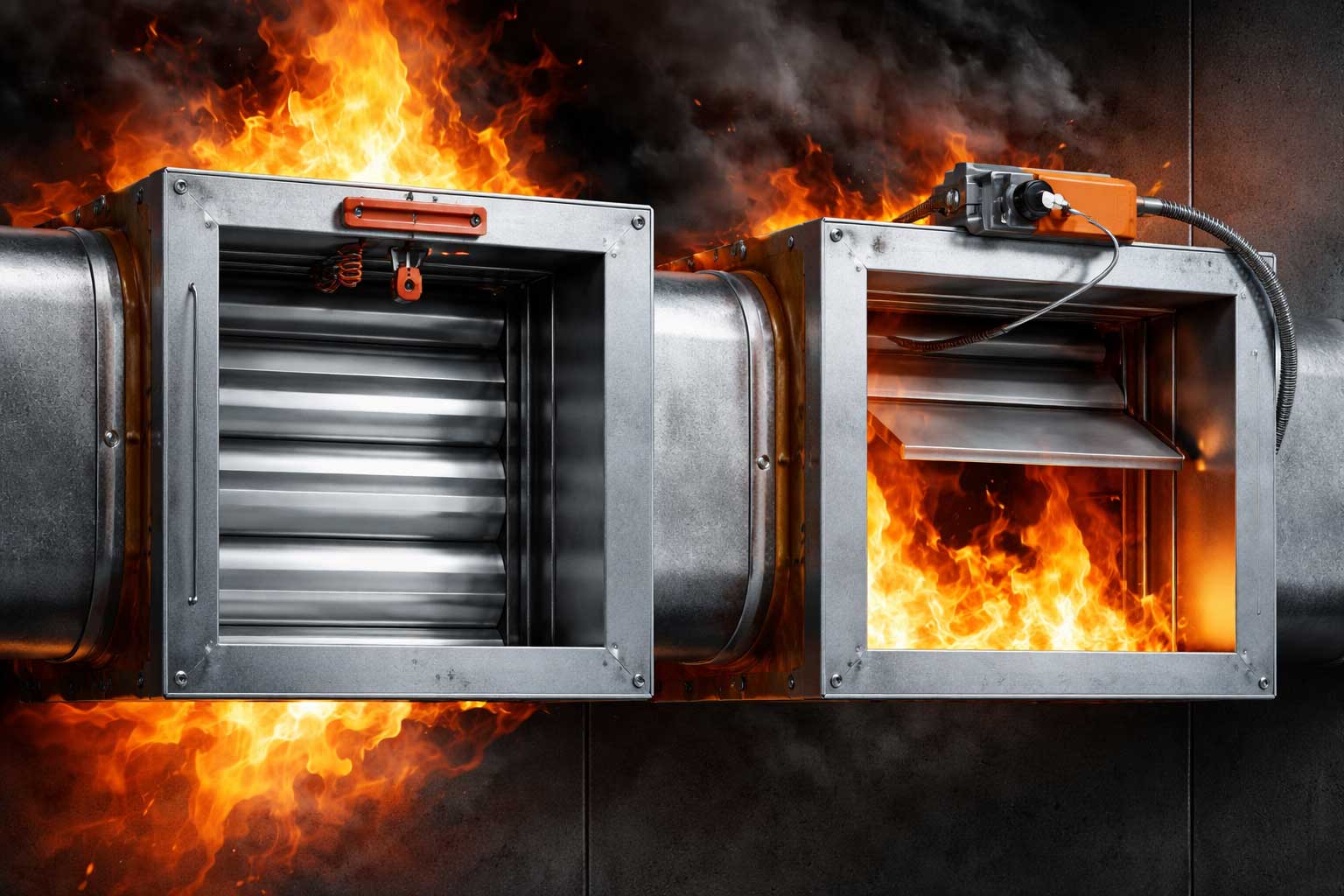
A fire damper is installed where ductwork passes through a fire-resisting element. If a fire occurs, its job is to reinstate the barrier at that precise point, stopping the ventilation route from carrying flames into other parts of the building.
Why a passive fire damper can work without electrical power
A conventional fire damper is deliberately simple. It normally stays open because a thermal release device—most often a fusible link—holds the blades in place. The link is engineered to melt or break after a specified rise in temperature, typically at 72°C. Once that threshold is reached, the blades spring closed and form a physical barrier.
Because the action is mechanical, the damper can still operate if the building’s electricity supply fails during an emergency. Fire dampers must be tested and classified to BS EN 1366-2. That standard uses furnace testing to reproduce the severe conditions associated with a real fire and assess the performance of a damper within a fire-separating element.
Smoke control starts earlier and performs a different task
A passive fire damper responds to heat and resists the passage of flame. A smoke control damper is an active device within the building’s smoke-control strategy.
This distinction matters because smoke is widely recognised as the greatest single threat to life during a fire. It can move more quickly than heat and can make escape routes impossible to see.
Smoke control dampers use electric actuators and connect either to the fire alarm or to a dedicated smoke-control panel. Detection of smoke, rather than a rise to the fire damper’s operating temperature, can therefore trigger them much earlier in an incident.
Depending on the design, a smoke control damper may close to keep smoke away from stairwells and lobbies, or open so that a mechanical extraction system can remove toxic gases. BS EN 1366-10 provides the relevant testing regime, checking that smoke control dampers will continue to perform under the temperature and pressure differences expected during a fire.
How buildings release, extract or exclude smoke
Automatic Opening Vents
Automatic Opening Vents, commonly known as AOVs, are central to many natural smoke-ventilation schemes. They can take the form of vents at roof level, vertical smoke shafts or windows that open automatically.
When the fire alarm detects smoke, it signals the AOV control panel. The vents then open so that hot gases can leave the building naturally. This helps keep escape routes clear and tenable for occupants while giving fire and rescue services better visibility.
Mechanical smoke extraction
More complex buildings may need powered extraction systems, using high-capacity fans to draw smoke outside.
Their operation is tightly coordinated. Vents on the floor affected by the fire open to provide an extraction route, while vents on the remaining floors are locked closed so that smoke cannot migrate through the ductwork.
Pressurised escape routes
In high-rise buildings and firefighting shafts, pressurisation can protect stairs and lobbies. These balanced systems use a continuing supply of air to create a higher-pressure zone that resists smoke entry, including when a door is opened.
Sensors identify a loss of pressure and the fans automatically increase their output to preserve the required pressure difference.
Basements and underground car parks
Spaces without natural ventilation require a specialist response. Systems serving basements and underground car parks often have two operating modes: an everyday setting that extracts carbon monoxide emissions and an emergency fire-control setting that increases output for fast smoke clearance.
These airflow approaches sit within the multi-part BS EN 12101 series, which extends across components such as dampers, fans and the power supplies on which they depend.
Curtains create boundaries where permanent walls are impractical
Large open spaces, including airports and shopping centres, cannot always be divided by conventional walls. Fire and smoke curtains provide an alternative.
A fire curtain is intended to descend fully during a fire, protecting locations such as lift shafts and stairwells. It will typically have a separate control panel and battery backup so that it can fail safely.
A smoke curtain has a different purpose. It may descend only 25% of the distance to the floor, creating a baffle that limits horizontal smoke movement between zones.
Both types of curtain must comply with Parts 1 and 2 of BS 8524, which call for extensive testing and rigorous third-party certification to demonstrate effective restriction of smoke spread. Their controls are often governed by the fire alarm, and the curtains must be included in the wider smoke-control logic if the system is to work as intended.
Competence and accountability in the post-2022 safety regime
The industry’s operating environment changed significantly when the Building Safety Act received Royal Assent on 28 April 2022.
Introduced as a direct response to the Grenfell tragedy of 2017, the Act established a new level of scrutiny and accountability for those who design, construct and manage higher-risk buildings.
Its focus on industry competence is especially important for life-safety systems. Anyone carrying out this work must possess the relevant skills, knowledge and experience.
The regulations also require much greater transparency, supported by careful inspection and testing of the services, equipment and fittings associated with a building’s fire strategy. Installing and maintaining dampers is therefore part of a regulated chain of responsibility designed to protect the public, rather than simply a routine mechanical task.
BS 9999: managing safety throughout the building’s life
Meritas applies the principles in BS 9999, the code of practice for fire safety in the design and management of buildings. Four ideas shape our approach to each project:
Risk management: identifying hazards proactively, before they have an opportunity to cause harm.
Proportionality: matching the fire-safety measures to the particular level of risk presented by the building.
Permanence: creating dependable safety measures that keep functioning throughout the building’s life, reducing the need for costly restoration later.
Fire risk assessment: using an appropriate assessment as a continuing basis for decisions about fire safety.
Following these principles and the recommendations of BS 9999 helps our clients meet demanding fire-safety expectations while supporting a safer and more sustainable built environment.
Maintenance turns design intent into dependable protection
Even a highly specified damper offers no protection if it cannot close when needed. The Regulatory Reform (Fire Safety) Order 2005 therefore places a substantial legal duty on the Responsible Person to make sure that the building’s fire-safety systems are properly maintained.
For fire dampers, BS 9999 sets an inspection and testing programme that will typically include a complete check at least once every two years, with annual testing in higher-risk settings such as hospitals.
Motorised smoke dampers and AOV arrangements need functional tests more often, confirming that actuators, control signals and connections between systems respond correctly.
Our checks include confirming that vents travel to the specified opening angle, that actuators receive the power they require and that each component adopts a fail-safe condition if power is lost.
Maintenance is not an administrative formality. It is the practical work that keeps the building compliant and protects its occupants.
Every component contributes to the first line of defence
Fire dampers and smoke control dampers do different jobs, but those jobs are complementary.
Fire dampers preserve the building’s physical compartmentation in line with Approved Document B. Smoke control dampers support engineered smoke management under BS 9999 and BS EN 12101.
Meritas works to ensure that the right systems are specified, installed and maintained to the highest standard. Whether the component is a straightforward 72°C fusible link or part of the control logic for a combined extraction and pressurisation system, the detail matters when lives depend on the result.
Our role is to provide the expertise and oversight needed to navigate the regulatory landscape and keep the building’s first line of defence ready to operate.
Meritas always goes Beyond Compliance, doing more than is required for every project.
Visit https://meritas.co.uk to find out more.